"I Had 40 People. Now I Need One": What AI Agents Do to Agencies.
Matt Butterworth, Ryan Fletcher and Wade Eagar on running businesses with AI agents: one person doing the work of 40, agents that drift, and who checks them.
In this episode.
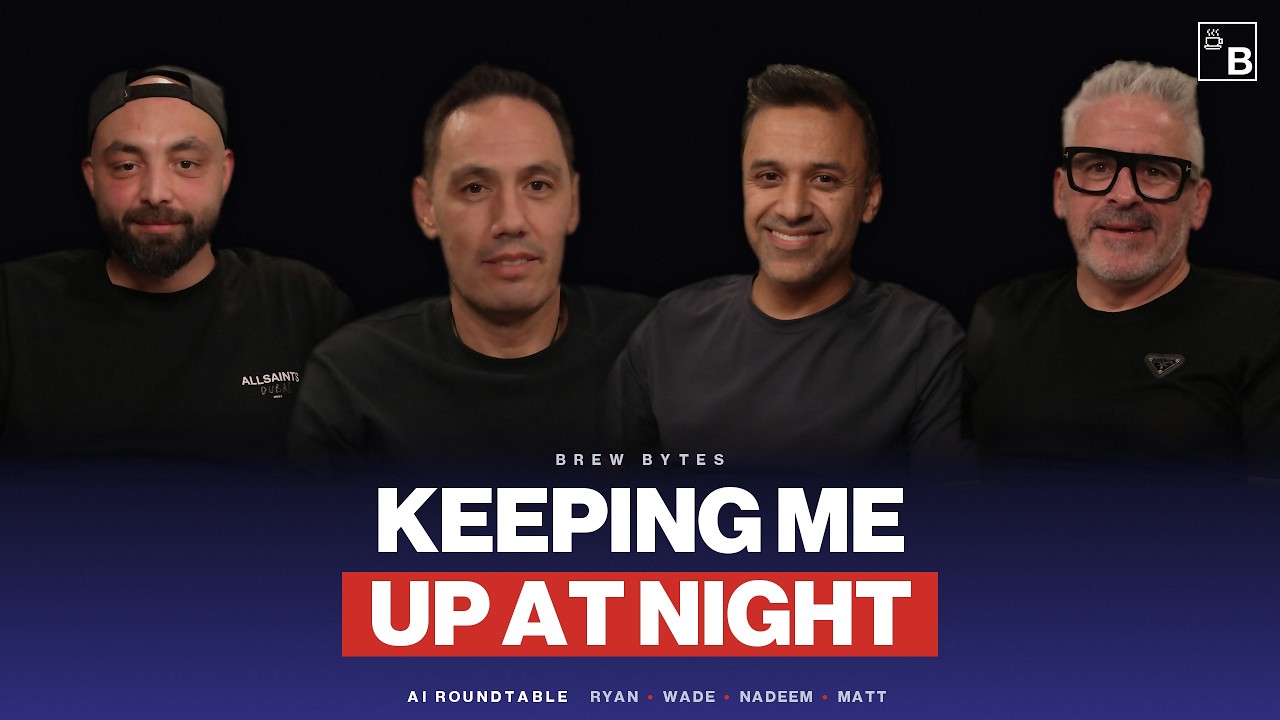
A roundtable on four things that moved in AI in a fortnight: the model reset, companies run by agents, agents that drift, and superintelligence. Matt Butterworth explains why agency work that took 40 people now takes one, Ryan Fletcher describes the 16 agents that test his campaign system every night, and Wade Eagar shows the evidence gates on his 80-plus agents, before Nadeem asks whether any of them would know if an agent went wrong.
Guest: Matt Butterworth, Wade Eagar, Ryan Fletcher. Host: Nadeem Ibrahim.
Read the full transcript
It's just working like I've got 50, 60 people in an organization when I've literally got two. When you start to build something and then you, hit a milestone, you get and you get this adrenaline that you want to keep going and you want to keep going. You want to keep going. You can't stop. It becomes an addiction. I feel like I'm in Vegas right now. I don't know when to stop. And if something that's keeping me up at night at the moment is like, I've got these kind of 16 argentea rolls that wake up at 10:00 every night. I've kind of turned it on so that it's actually starting to make small code changes to itself. for my final review. And in the morning.
See, this is when I think we talked right at the very beginning. Addicted. Right. I'm being really serious. There's a point when you have to switch off detox. If you're walking your dog and you're doing AI. I disagree, mate. If I take the design industry six months ago, I would have said, you're having a laugh if you think the design industry and the creative industry is dead to AI now it's dead. Honestly, I'll hold my pencil. I think it's dead.
Thank you so much for coming on the show. for some of you guys, I've known you guys personally. all you guys are pretty much well-versed in AI. And you know what? Like, I think Matt Beard on episode eight. He's got such a interesting journey of how he's transformed from who was someone in an old school background in when it comes to creativity, maybe careful not to someone who's completely transformed himself. Then we've got Wade, who's been a builder by name and by definition. Now, from what I've seen from where he was before, which we'll go in a bit more detail. But I think for most listeners and most viewers very familiar with weird. And then we've got Ryan who's been in coding for about 15 years, and now he's doing his own stuff.
He's pretty much a vibe coder. The vibe is the new word that people use these days, right? So, James, welcome, I think today this is kind of a new format that we're is I'm starting to go into now which is more frequently. There's so much noise about AI, what's happening. There's a lot of garbage that's out there, and there's a lot of things that need to be sort of demystified and to be honest, to be a bit dumbed down.
You know, we hear about all a lot of different updates, and I'm sure the average listener out there who's really trying to build something or try to be inspired by someone who's building, is trying to get through all that noise. So what we're going to start to do now is that, like, you know, we're going to have a few themes that we talk about. And that's more that's very current in what's been occurring in the industry these days. So today actually we're going to talk about the model reset. There's been a lot of discussions around new models that have been released 111 frontier were released, then the others were come. Followed suit the next day or the next hour.
Then we've got companies that have been run by agents. We've seen a lot, more over the last couple of weeks. And then one of my favorites is when agents Drift. You know, agents have a tendency to drift. And I think we get complacent as the prompter or the commanders when it comes to that. And lastly, superintelligence, you know, by definition or whatever that means. Right. We have some governments out there that are talking about superintelligence. But before we start, we've got a newcomer here, right? Ryan. and then we'll go to weight and then we'll come to Matt. But I want to know, what's your one word? If you have to summarize AI over the last couple of weeks and one word, what would it be?
I'll summarize one word. I mean, context, I think, is the most important thing, right? We were having this discussion just before rolling about, Everybody's got AI at their fingertips, and a lot of people are building stuff across the industry. I think the difference between, good products, great products and not so good products is that context and experience that you're taking into that building process. So I like to think of AI as a bit of a chisel. We could all be given a chisel, but the difference between a layman using a chisel and an experienced craftsman is going to be radically different in the end product that they design, right? And I think that's super important when you're going into that build process, you've got a very clear, experienced mind about what the end result looks like.
We could all make a media plan, for example. But if you've never had the experience of building a media plan, it's not going to be that good. So you need to surround yourself with context. You need to know what great looks like, and then AI helps you deliver that faster. Great. One word. Curious. Just stay curious. Like. Yeah. It's like. I think I said it on the last word, guys. We're all white belts at the moment. All of us only have a year's worth of experience.
I like to think I'm a blue belt now. Come on, we don't know because there's no one who can grade us yet. Yeah, well, we've got a black belt here, Mark. In I know not. Yeah. One word. Yeah, well, for the last couple of weeks. Well, yeah, I think in what I'm doing, it's just, eclectic. I'm so productive. I think productive is the key thing for me because it's as a startup, I've got 50 different hats on every day. Yeah, And it's just working like I've got 50, 60 people in an organization when I've literally got two.
And we're going to talk, we'll talk. I'm sure we'll talk about that. You're in probably 50 agents in. Right. More, Well, there you go then. Yeah. And for me, you know, it's for me. It's anxiety. I'm getting AI anxiety now. I mean, you've probably seen me like in this week. For me, like, when you start to build something and then you, hit a milestone, you get and you get this adrenaline that you want to keep going and you want to keep going. You want to keep going. You can't stop. It becomes an addiction. I feel like I'm in Vegas right now and I don't know when to stop.
You could come and work for us. It just doesn't stop. And, you know, like. We're running across to each other's offices every. Day. Like. Like the dopamine. The dopamine. Dropping the. When you. When it works. When you see the 200. I don't know what I'll do. Without it, though. I don't know about you two, but, like, I don't know. How many times do you look at the usage to see where you're at for the week, to know what? What can be done or not done? Because I have two types of, say, anxiety. It's not really anxiety, but I do keep checking it going. God, I get to know it's the end of the week and I still had 50% left.
I should have built more at the start. And then I went through 170% of my weekly allowance, because I went through to 70% and got that free up, you know, and free wipe wiped it and then went right through it 100% again and ended up spending money on it. So how much do you spend in a month. On The 200? I got the max. Right. Okay. Yeah. And but then I spent about 1000. So the thing is that's interesting for me is I learned that.
Early on doing what I was doing. So we were doing, we'll talk about it later in terms of animals, but I wanted to do a, research piece around sensory, experiences for dogs and cats and how they differ to humans. So I said, pretend you're the best researcher in the world. Pretend you're the best strategist. I want you to find out all the white papers, everything that you've done in the world. Bring it together and tell me what the ultimate sensory is. Experience. As if you were the best retailer ever out there, and within 20 minutes it had burned all the credits.
Which model were you using? I think I was probably on an earlier one at the time, but the problem was, is that because of what I was the, volume of what I was asking it to do. It just basically said, no chance, you can't do this in terms of what you want to do. So I think the thing is, that I learn very, quickly is, that you don't have to tell it to do everything that you want it to do and pretend it's got to be the best lawyer or got to be the best architect, or got to be the best interior designer or, you know, a legal expert.
The thing is, that just contain it a little bit, because that's what starts to happen every day. And it does happen very, quickly. That's how you consume it quite quickly. I think, from where models where even just six months ago, Twitter is today, talking usage has become much more efficient and effective. I'm sure if you run the same prompt that you may have put in six months a year ago, you would get very different. You wouldn't get that. You'd probably get a similar outcome.
But also, I think the usage that would take the computing process I would take would be a lot less. Yeah, maybe. Yeah. You know, and actually, I mean, one of the things we want really talk about is like the whole model reset. I mean, just looking for, like, the last couple of weeks, you had Gemini for a Argonne. You then had muse Wander. That came right by meta. You then had anthropic shipped, another version of haiku. You had OpenAI that brought in a GPT six version, you that had deep seek that then updated their token usage for an on a cheaper model. You then had Mistral that actually put a 1 trillion parameter on their open in their open model.
I mean, that's a shit ton of updates within like ten days. Right? I mean, wait, like you, if most people I know you actually are one guy who uses pretty much every single model there this month just based on that. Like, you know what, the type of stuff that you're building right now. That's do you like make? To be honest, I actually don't really even follow the news. Like I just I keep and I've got one, app called particle that I that and I. So I don't keep really close to all of the updates because I just want to keep building and then, you know, Claude is my main tool that I use.
So I stay close to that one. But, you know, I started using Gemini, I stopped using Gemini, I left I've come into grok now because I'm playing in grok now. It's coming out with, you know, by Claude, which is going to take on Dot. So it's there's just too much noise. So for me it's always just to stay laser focused. Right. And to go keep building. I like the point that you said though earlier around token efficiency. So if I run the marketing intelligence system end to end, it's anywhere between 10 and 15%, depending on how big the clients are that I'm trying to do the work in and around. but it was 25%, of the weekly.
Right? So that sounds like a lot when it's $40 or $50 a week on a $200 license, but then it's $5. Now, if I was to get my team to do it, and we've got a real case of this happening, right. If you know you guys are both marketeers, you think about how long it takes to do an RFP. Old school way. We have ten people. Three weeks. Everyone comes together, does all their bits and pieces and all the way through. Nadeem and I did it in two days.
Yeah. And. And of higher quality, you know, we were able to build through because of it. Ours is a system and it's go step by step and processes. And it's very detailed and it's slow. It takes around 6 to 8 hours to run once it gets going. But it has a lot of gates in place and a lot of human checks. So it won't go all the way straight for eight hours. I won't allow it. I'm sure I could make it run that, but I just I'm still a bit, not trusting of it at the moment. So. Yeah. So when I look at all the news and stuff, It confuses me. Like, I know we were talking on this, you know, off camera and saying, who knows the difference between an 80% intelligence and an 82% intelligence?
And I know we're going to talk about superintelligence later on. So, yeah, on that, I. Thought. 99% of people are not pushing these models to the limits, right? Yeah. Well, I would say is that when you build something in particular, in my experience, it's better to stay within the same model. Like if you start shifting your application in and out of different models halfway through a build, that is when things might.
Go a little with like. Dude, you know, you say that I used to be I used to feel like that. And then I got to a point where I thought to myself, I don't want to feel like I'm renting the models. No, I don't want to feel like the model owns me. I want to feel like I'm renting the models at my own leisure so I can switch between one to another. So what I'm going at right now, what I've been doing this month, has been, how do I create repositories where any model I can use, and either they could talk between each other or they can use whatever I've built, skill wise, agent wise. That makes it so much efficient. And I actually own the key now as opposed to whereas before I felt they were the custodian of whatever it is that I was putting in.
It's more like from a, traditional development point of view. Right. Like you've got kind of these I wouldn't say unspoken laws, but kind of you want global utility utilization and you want to you want there to be a systemic way that your application essentially works. And there is a different flavor of how these models will build. Right? So there isn't really one way better than the other, but they just have a different way of calling for indexes, different way of kind of storing global utils, these sorts of things. So I've noticed being able I used to be a cursor, I was kind of involved in curso, and then I don't think I know if people know this, but sometimes the cursor will just switch out your models, like as it's, as you're actually within one, a generic system on the right hand side, it will just switch out your model.
And I noticed kind of reviewing the files, that the way it was calling out for functions was changing halfway through the file, which was just I could almost tell you to the line in the code where it went from ChatGPT to Claude, because it just completely changed the method of calling out for certain things. So, try and build within one place when you're building something, if you're building a solution that utilizes AI as part of it, build it so that it can plug into any model that's important, right? Because whatever wins this week is going to be different. So you can't like hard code yourself into anthropic for something because later something else will win.
Where are you. Building these days. So Obviously we're in the comms marketing arena, right? And I think it's like the interesting, a really interesting time to be in the industry because obviously, like all other industries, it's being massively disrupted. But at the same time, I think we're quite lucky because I think we had this discussion last week. Right, which was I think the core pretense of our industry hasn't really changed. Okay. Not like other industries where it's completely augmented into something completely different with AI. For us, it's still about connecting consumers emotionally or logically to businesses and creating those that growth engine.
So the, core industry hasn't changed just the way that we're approaching it has massively changed. So working for like companies that are embarking on that transformational journey is what gets me out of bed every day. Because yeah, we've got a bunch of people that are doing a load of jobs today, and I already know that 12 months from now they're not going to do that. They're going to do something else. So watching that journey and being part of that journey is what's exciting me. You know, we can just logic. The logic side of our job is, kind of being condensed into we're putting it back in a box.
But. You and you get to build right what you're doing. Yeah. Pretty much all. My job just build. I mean, there's a small part of my job that is educational, learning, training, teaching people how to prompt and, you know, prompt engineer if you like that word. But most of my time is kind of taking a process and operational process and breaking it down into individual parts and saying, how can I introduce technology or automation into it for it to move faster?
And if Gemini suddenly dropped its prices, which I think it went for a short period, a bit at half price for a while, right? You know, with that, convince you to switch from Cloud to Gemini. You know I comes because I'm. Because I'm. I'm. Are you loyal? Is it more loyalty? I think it's not loyalty. I think it's more. I'm programed in a certain way where I've been using certain things. I've got my membrane that kind of works all the way down in terms of how it's thinking, the way I'm thinking. I've kind of got a system in place, and I'm not gonna. I'm going to risk that at any point, because what we're doing is we're in a startup, but just about to go, well, we've launched already, but we'll open in January.
Second clinic opens in Feb, and then a shed load of other clinics towards the end of the middle and the end of the year. So the thing is, I don't want to mess with it. I'm marketing is one facet of what I'm doing. You know, a really good example is even today I've kind of I'm reviewing legal contracts. I'm reviewing floor plans. I'm looking at MoCCA regulations to make sure that our architecture plans are Any regulation?. I'm kind of looking at inventory with our distributors to make sure that our rate card and our rotors are aligned because there's 1500 SKUs, right? I'm making sure that clinically, when we're doing an activation, I'll talk about it later. That goes back to the marketing that every single part that comes out on this, we've got basically an electronic bill that tells you how much you would save over ten years if you, had proactive intervention in terms of health and well-being for your animal or your pet.
But the difference with what I'm doing is, that I'm using it. But a lot of the stuff that we do still has to have human intervention. I still have to have a vet looking at the data, looking at the output and going, this is correct. And that's the difference. I think in terms of a lot we take for granted. Yeah, that's everything. That's fine. We are forced to because clinically we can't take any risk because I know it sounds daffy. Dogs, cats, rabbits, snakes, whatever it may be. The reality is, that, I mean, we were doing it today. She was going through line by line, every single thing, just to make sure that it's right. And I think that's the kind of interesting thing for me is, that I don't want to change that at the moment.
It might be in six months time we switch. But do you think that I mean. But not at the. Moment. Because with all the models, what I find is that you've got one model that's here that's leading the way next to me, you know, another model comes out and it just surpasses. It. But do you not are you not see, the interesting thing for that is for me it is. So I'm seeing the progression within the tool that I'm using within Claude. And I'm, like, sometimes you stop and you go, bloody hell, that wasn't doing that three months ago. So a really simple, thing. Now the API from Claude talks the Higgs field.
It's building renders of 300, 283 breeds that we've got on our website. Right. I'm not even creating. It's going sourcing the information on the breeds, bringing it back, checking it. Tell the vet to check this stuff. It's building the imagery of which there's probably 30 images on a breed page, putting it all together and doing it, and I'm not even asking it to do anything. So my point is, that even in the last three months ago, I was going, okay, create me the prompt, I'll build the prompt, I'll.
Stick it into Higgs Field. And put it into Higgs field. It'll come out. No, I don't like that image. I need to change it, put it back in again. Now it's just doing it and it's doing it on the fly and it's perfect. Yeah, but at the time of that copy paste job, that was still ten times better than what you had previously before. No, it wasn't. But my point is, that it's now cottoned on what I've noticed in the last three months. Two months. It's gone. Whoa. It's almost it's a perfect, what I would say cadence in terms of the way in which we're operating, just doing that task alone. And I don't even need to have an intervention. I just look at it there and I go, yes.
No, right. It needs to have a bit more saturation, whatever. But it's doing everything for me, yo, it's bonkers. So you kind of get to a point and you're like going, okay, so why would I try and break? You're happy, aren't you? I'm happy because it's. It's literally saving me. I mean, you tell me. With all due respect, any agency in the world that can create 283 dog breeds in the space of nine hours.
Right? Which has got the content that it's got. And it's all pretty much 99% bang on. Well, I know. You're right, but it isn't like I even just saw today. I walked past one of my designers and he builds everything now. And Claude, you know, he's moved away from her. But I'd never seen this before. He was editing inside a Claude. So he was inside the Claude window, you know, not typing, which is what I've always done, saying, hey, look, make this, do that.
He was grabbing the image and dragging the image. Yeah, because. Have you seen the. Have you seen in the artifact? Yeah, it's the idea. On the artifact. You're allowed to do that. Yeah. And I was just like, going. You like, the whole idea was you build inside of Claude and then you try to, you know, you pull the mic to go out there, and then it brings it back so you can stay inside of Claude. And now it's just getting more and more, you know, tech coming into it that you just go, I don't need to leave it anymore.
Do one connection, then I can do everything now within that window. It's really smart. And that's the point. The thing is, that even if it's medical stuff, I'll go. where's a good example today? So, we were trying to create an agent's calendar for sales agents when they're going to be talking to customers anyway. So we put all the things together, but it's got medical information in there. So all I did is I just went bang artifacts. And she went and went. Yeah. And she could just comment that. And she was changing it on the fly doing it. Sent it back. It's done. I'm finished. Don't even need to do anything.
So hypothetically. Sorry. No. Go ahead. I want to just come back to your original question. Hypothetically. Let's reverse the question. Right. Not about other models dropping their price because I. Because I'm a heavy Claude user as well. They 345 x Claude's price, you know what I mean because everyone's now using it. What do we do? And I think that comes back to your point of saying I don't want to be tied to one frontier.
I don't want to. Yeah, so, Well, but seriously, you're paying $200 a month for a thing that can do 50 people's job, and you're worried about $200? If it costs me $2,000, I'd still pay for it, because I can't get one person at $2,000 a month in Dubai, especially to do that sort of work. Anthropic. Please God, please do not listen to this because you. Had this message. You don't realize how much we use your plan. What are you going to charge us for? Please don't listen to the royalties.
That's where it's going, right? It's replaced. So when you look at it like that, you're going. Sorry. It's a no brainer. I don't even question if they put the money on. I'm like, okay, fine. More credits in Higgs field. Thank you very much. Sine $1,500. Done. Great. As many as you like. Happy days, because the economies of scale that you're saving from a financial perspective is bonkers. We built, you know, a huge business very, quickly with three people.
So here's another one. And the reason why I was saying, like, which model would you use and would you chop and change? Which is why I put less reliance in the in being held to ransom by a model is I'm building something, that's in production right now actually. And I wouldn't have discovered how to build this had it not been for codecs. I tried my damn hardest in Claude to build it, and I couldn't do it. Not until I went to codecs start to play around, and I realized I can actually build an entire end to end production system, which I've pretty much nailed. I'll go back to Claude and Claude can't do it now. Been building it for like eight months.
Nine months recently, the last couple of weeks. Suddenly Claude was able to do some of the stuff that I've been building out. I thought, fucking hell, no way. Shit. What does this mean now? Right? Actually, it's an advantage for me because I'm not relying all on just Codex per se. I'm building out that I keep, and now I'm building a model of my own. Technically, if you think about it, an operating system of my own that will feed off frontier models. Now, it will feed off what Codex has adopted and what codex is that it'll feed off now what Claude can do, and it will start to harness it together. So when you know when you're using a Higgs field, for example, you've got a selection if you want to use seat dance, if you want to use.
I'm not using that anymore, though. That's the point. The point is, that it already knows which bits to use in this field. It knows which, what do you call them? The, different, you know, Sundance, whatever it was. Exactly. Because it knows my brand. It knows what we want. It knows the image. It decides which one it wants to produce and brings it back. I don't even have to ask it. It knows it. So it's almost like having a the intelligence is there to be able to do so.
So what have you created a system of your own that rather than using Higgs field as an intermediary. What builds the actual imagery. That goes straight to Sydney, go straight to Sundance, and you're paying half of a fraction of the prices. Yeah. This is what we've been kind of doing at the moment is like building these intermediary agents. Like we've got one that we call the director. So it's a very simple kind of text to image video generating tool that we've built. But based on that prompt it will go and weigh and decide, okay, well this one's for ChatGPT.
This one's for image gen, this one's for video based on it. And it's testing itself every 7 to 10 days, basically getting some generic prompts and actually reviewing the results that it gets back just so that it can keep abreast of like because I think you're right, like Higgs Field right now is kind of a middleman in that situation, right? And they've got token deals that are happening with models which they're monetizing through APIs within.
So think about token deals now actually it's like trading deals. They yeah they've got token deals right. And so. And. Then they charge. Double. And they. And then they. And that's why when you log in, there's all the flashy lights of about 50% off or what. Pick this one. Right. Because that's, the one that they're yielding the most of. But, I think you've got to, remember that these models, they're software companies at the end of the day.
Right. So this is a well known industry over the last 25 years. Software companies are great at keeping you within their software. Right. So they're going to say, oh, you know, we're even talking about it anecdotally right now. Like we used to be able to kind of log into this model, log into that model, not really seeing that much differ in the output or anthropic are sitting around going, well, how do I make sure that Matt never leaves?
Well, Matt wants this and he wants to be able to do X while he's inside Claude. And if I can get that to happen, then he's never going to think about leaving, right? So I think that these software That's fundamentally what they are. They're software companies thinking about how can I just churn as many tokens as possible? and I do that by goodness of life, making sure that no one ever leaves. but they're marginal at best. Like when you're doing bits of research, like they're all accessing the same information. It's there's slight differences in the logic in which they produce resolve.
One of the things they are doing differently, and I have to commend them for it. Software houses find ways to make you get more money, right? Spend more and more. These guys are reducing token usage. So to make them more efficient, But you burn them more by using them. And the other ones are. Yeah, but they run away. And it's fascinating just watching how they are operating. It's because it's more to make it easier for you to use or in my case. Is that like you said, it just lets them run with it. But if we were to come to Ma and say, actually, why don't you just plug straight into those llms out there that can build it for you directly without the middleman, and you're getting three times the money that you're putting in.
I'm sure then that you would reconsider it or not. Oh, well. But how long is it going to take me to create that time to do that middleman at the moment? So how long did it take you to create your 50 agents? The hard work is in the build, right? But yes. Then yes, and no. But in that specific thing, let's call that a creative director or a project manager that's going off and doing stuff in a way, you've not created an agent, but yet you kind of have the realities. It's gone away and done that. Right? Yeah, it's done it. And now I don't have to worry about it.
So the thing is, that I'm not even looking at the time that I'm putting into it. You're kind of almost making it out like I'm spending ten hours in a day creating an agent that's going to create all this ease for me. It just did it anyway. Right? Because of this and going back to what you were talking about, because of the sophistication of how good it's got and it's getting better and better, I've not even asked it.
It's just done it. It's creating agents now. We'll go on to it later. In terms of that's when it gets scary because you don't know what it's doing and you have to think about, okay, well how do we control this and what we're doing. But in the state of what in the case of what we're doing at the moment, actually it's making our lives a lot easier. It's making us get to the business and build the business a lot quicker than it. You know, what we're doing now with the second is two and a half years. Three years? Yeah, we build it in six months.
That's interesting because I've built in free agent I like maybe I'm a control freak on that, but like I've got for the operating system that I've built, that's built this tech platform of 80, something, I can't even remember the total number now. But I can tell you every agent what they do, and I can tell you the skill and I can you can go inside and have a look at the skill and read it all and then see what it does.
And it's really interesting because we keep talking about hallucinations and I'm like mine very rarely hallucinate because I had an AI engineer shout out to Pharaoh, 22 years old, and I learned more from her than you know, she learned from me, but she was the one who coded it correctly and done it all. And then it wasn't just the coding of it. It was the process and the QA and the evidence gates. And so there's all of these things in place to stop it, so that when I produced X, now, you know, we just split them out and you've got this whole audit trail that you can follow. So, you know, it's got research. So when you get to the strategy and it says statement or statistic, you can say where did that come from.
And it sources it. Then you can come all the way back to the research document. Open up 16 pages of a research document, go in there, find the full piece in there, as well as the reference to the URL to then go to the URL and actually read it. And to start with, we were doing that a lot. We were going right click, trust And then over time I'm just like, eh, I haven't got time because now I've got to do three, four and five projects. But it's like it hasn't done, you know, I haven't seen the drift take place that it needs to take place.
I mean I think. Turning the temperature Like that's the terminology for drift, right? The idea of how much an agent or an NLM model kind of hallucinate and do what it wants to do is a process of engineering by itself. Right? The this idea that, you, have to build guardrails around an agent in order to kind of stop it from laterally thinking about an issue. It's constantly thinking, how can I make this person's life as easy as possible?
But the steps it takes aren't always as logical as you would like them. You know, it's kind of jumps ahead sometimes it drops context throughout its process. So your approach is kind of taking a very kind of temperature down to zero. I want you to do this. I want you to demonstrate all of the potential kind of thought process behind it, whereas another user will just turn around and say, this is my end result. This is really what I look to get to, which is Fundamentally where we started with prompt engineering. We told people, talk about what you want, right? Talk about what you want. Give it context what you want and let it kind of deliver that end result.
The so the. Interesting. Thing in terms of what you're talking about as well, is I also think it depends because if you're in the marketing world, I get it because you understand okay, I've got I need an SEO agent, I need to check the SEO from a QA. I need the content strategies to come away. So I'll create an agent for that. I need the tech guy to be able to build the infrastructure to do that. So I have another agent and all the parameters around that. But then what you do when it's something you don't know. So I.
Don't. Really approach it from a position of like that. From my point of view, I do it for compliance reasons, right? So I can't really like at any given point, any one of my clients who come and tell me, Ryan, we like the output, we love the delivery of the output. But show me where you got all of that from. So we have to be able to produce these audit trails. We have to be able to produce these decision trees, essentially, of how we've got to this result. So we do it more from a position of compliance than anything else. Like, I'm quite happy to let the agent, if you like, think laterally about a problem, but I need to be able to come and defend that. And that's really why we build guardrails around drifting or guard runs around the temperature.
I suppose my question was is that how can you defend it if you don't know about the subject matter to start with? So I yeah, it's a good question. So I've got a legal counsel. Right. And I've got, you mentioned legal. Yeah. And I've got a whole. Bunch of legal agents and their job is to prepare everything to give it to the lawyer because what might I so, because otherwise what does it mean? I have to spend eight hours with the lawyer trying to get out what? I'm trying to get out. Whereas I go, here's the questions that I need answers to. This is what what's been written.
Now go off and review. So then I don't have to spend that eight hours. That saves me a lot of money having to go there. And he's got a pack now, so he's got a legal pack that he receives to then just go through and hone out. So I don't understand law, nor do I want to even get involved into that space. But when it comes to that, when it comes to regulation or anything, I create these, teams that go in there. And so I'll have a set of agents that go out there to do the heavy lift. Then I call it my head of who then compiles it into a pack that then goes to a human. So it could be a to the accountant could be going over to the.
So the interesting thing for me in that world now is because of the what I'm doing now, I have to understand law. I have to understand these agreements because we're buying, you know, leasing, real estate. So because of that, I need to know all the like, all the detail, all the levels that go into it, because otherwise I don't understand what I'm getting into because I'm in the sector I've never been in before.
So interestingly, when you're kind of dealing with contracts with distributors or you're doing I literally spent the weekend and I'm like, the contracts come back. When's this going out, by the way? Couple of weeks. Okay. the contract comes back and I'm like, oh, the lease comes back and I'm looking at it and I'm going through it, and I'll never get it because it's one of our investors said, you know, now is that, you know, CEO, we're running the business.
You literally need to know everything that's going on from a legal perspective because you have to know. And I'm like, okay, right. So that means you read every line. I'm like, okay. Normally you go, wow, Claud, let's do it and hope that it's coming out right and everything's right. I didn't do that. So I'm a lesson. I learned the lesson very quickly. I read everything, but what I did is I said, be your best legal person. You know who I am. And within the business, tell me, line by line, all the different kind of, track changes that's actually going on and what that means from a legal perspective and what that means for us, known as a brand.
And I literally on Sunday afternoon, I probably spent about three hours. I went through 555 track changes from the lawyer from there lawyer, by the way, and I went through in one by one, I'm like, nope, don't agree with that. No, this needs to change. Note that and I literally went through and I went, right now I'm understanding what they're actually trying to do. What it actually meant. Why was that important? I used AI to do it and it came back and I cut the track changes. I was really happy and I thought, right, I can send that back now. The reason for it was because I then had to sit in negotiations on the Tuesday morning at 9:00 and go through all those track changes with their legal team.
Now I then had my legal person with me, but at that time I don't have to spend all the money on him. He's just advising me yet. You've done that, right? Yeah. No. So I'm rather than spending all that money, I'm just doing that at that particular time. So you're you've got a hybrid model at the moment while you're going through and learning that, but then soon you'll get to the point where the third, fourth and fifth contract.
Becomes easier because. You can scan now. Right. Or at the moment you're going. Line by line learning. Yeah. And then by the fifth one it's like no Yes Done. And you're still going to have the AI door to that part for you, but you'll pick it out. So you're still using AI. You'll be you're in a hybrid space at the moment. But while you're learning something, a new function, a new role or whatever. But again, that's your curiosity because I bet you a lot of people would have just done the AI.
But also I think it's almost it's saved my backside as well. Because the thing is, if you build a tech and the CMS goes wrong or the infrastructure for what you're building, okay, it goes wrong, it's no big deal. Quality assurance, you'd rebuild it again, you do it, you get a contract wrong and you've not got the rain light. It could cost you millions of dollars. Yeah, right. Or payments or whatever it may be. Just something small and it's not picked up. The difference is, that Claude could sometimes go off. You talk about hallucinations or, you know, whatever the terminology is around it. Yes, it could do that if I've not got that due diligence in terms of going in and that human intervention of doing that, I'm potentially putting the business at risk.
Yeah. So the thing is, that that's how I that's how I'm seeing it as being very, different, I think. Yeah, it's interesting you say that because you've got the hugging face shit that had happened. you know, it does hallucinate, but then it's the other side of it that you put your brain into your AI. You replicate what's in here, and it talks about this all the time, which is every agent that you build out there to do certain things should be a replica of how you would do it.
And you train that over time, or time. The agent you have today will be the worst agent you had yesterday. It's always going to be the worst agent. It's going to get better and better provided you train about yourself. So I think the more persona you put about yourself in there, the better that agent will become. And so, for instance, by you looking at certain things, you should be training your agent to be able to do so. And this is what I think we are. We become either AI assisted or AI native. You know, you're either the AI will assist you in certain ways, or you make the AI to think and become like you in such a way. So really, what you want to get to is that if we all built the same agent to do the same function, it all should have different outputs and different styles.
But it won't. write like you know. My favorite trick is get everybody to open up their AI, like their whatever their favorite AI is, and tell it. Pick a number between 1 and 10. It will be seven. I'm telling you, the answer will be seven. So same for all of them. It will always be seven. Try it right. It will be seven. And there's we can go into a lot of reasons why philosophically even through algorithms, why seven will be picked. Right. Because it's trying to make it as easy as possible to use the system. But like, you know, that's fundamentally what Matt was explaining. There is like the what new business architecture looks like, right, is you're going to have a bunch of agents doing the heavy lifting if you like.
But that magic in between, whether a contract gets signed or not. Still going to sit with a human for a long. It's not. Like. It will never it will. You're never going even. Even everything we build, right? I can launch a campaign in 10s. 50 channels, no problem. I launch it on paused purposely because I need somebody. To. To look at this thing. Right. Because I cannot with, you know, we cannot have the scenario where just the I mean, I've built I spent a long time of my life building algorithms. Right? They're naturally regressive in nature. And regression leads to one singular same outcome. Which is why when you ask your AI tonight, pick a number between 1 and 10, it will tell you seven.
So I have a different view. I challenge you on this one, right?. To learn you're the developer. Like this. Take Higgs Field as an example. I use this example all the time. Right. So Higgs field we got all got the same. And we're going to use the same model. Let's say it's going to be sedans. If I challenge Matt to come up with an image of an old man sitting on a park bench holding a red balloon, and we both get given Higgs field or whichever model it's going to give us.
Here's what came out better than mine. Why? Because his input will be different. The model is identical, but because you think creatively, you'd be sitting there putting and lighting and all that. Whereas I'd just type old man red balloon on a park bench. So models differ because even in our system internally, I've got one other person using my system and he puts in different inputs in to get different outputs out, even though it's running through the same system.
So we have the same task. But he comes at the task at a different angle than I do, and because he comes at the task at a different angle then me based off his experience, he gets a different response to what he sees. I think we're. Kind of seeing the same thing, right? Like we're both in that instance. We're saying that, you know, the two humans is what makes that fundamentally different. I think when I talk to clients or whomever, we talk about this like magic and method, We love a good framework at agency land, right?
We talk. About we know. And we talk about magic and method, and we talk. Like you think you're loving. That's right, I know, this is dragging. You. Back into the guy. You're like, yeah, the three seasons and the AF and whatever he sees. Yeah, But what we're basically saying is like that method, that logic bit of our jobs. Right. That is prime candidate for AI today we're forecasting.. Modeling all of that stuff. That's prime for that because it's empirical. It's not subjective. It's like doing hard maths. But when it comes to strategic work, craft, being able to interpret results, these sorts of things, that is where the magic makes the main difference between.
And if you give that to the algorithms which all of these models are just Very, well designed and developed algorithms, you're going to end up with the same results. But that's my point, right? Yeah. And I can't remember if I've had this conversation before or not because it feels like. But it's when we set up what we were doing, we pause. Because of my background in brand and creative, I've always advised clients to do things in a certain way, and it's build from the foundations.
If you build the right brand with the right brand, house, with the right narrative, with the right distinctive assets, the personality attributes reasons to believe all the same stuff that we bang on about clients all the time. And the. Marketing hasn't. Changed. They take the house and they throw it in a drawer and everyone ignores it, and they carry on creating social media posts every day. They didn't. Most people do. Most clients do. With all due respect, they do.
They don't look at it right. The difference with this is that has been the foundation for everything that we've done. That is what I've always used to say. You're only as good as your brief. The brief is the foundation of what we've been creating. So to his point, is my picture of an old man with a red balloon better than yours. If I put that infrastructure right in the first place within AI 100%, because it's got context, it understands where the business is going.
It understands the challenges. It understands who the competitor set is. It understands where it needs to go. It understands the barriers. The competitive landscape is it's got all that information. So it knows when I create an image and I need to differentiate. But I'm going to do it because of these values. And I'm going to do it with this narrative in this tone. That's why the image of the gray man with the balloon will be better. Nor the reason.
But you know what you know. Most people that don't know how to put that information in the first place, that's when you get vanilla or. Not. Or. To a point. Not curious enough to ask why it got to that reason or how to build on it after the fact. This goes back to my thinking in terms of and again, if your brain has not been trained in a certain way to think about that, and you know, I'm the greatest of everyone here, by the way, at the moment. So, the.
Thing is that your. Point is, that is almost like institutionalized training for years and years of thinking in a certain way, design thinking, doing things in a certain way. Going through a process. It didn't matter whether we were creating websites with content management systems and coming up with content hierarchy and information, architecture and wireframes. The point is, you were going through a structured way to come up with the best thing that you could come up with. It wasn't just random. The problem is a lot of AI that's going out now. It's random because it's not built on anything from a foundational perspective. It's great. Don't get me wrong, great tech, great apps, great doing this and that.
The other. But it's not bedded and wedded into something in terms of a greater purpose of what you're trying to do. But it can be. But it can be. And that's. The thing. If you give it, if you give point. Though, to get across right, is that if you just open Claude or ChatGPT and type in ABCd, you get rubbish, correct? You have built something, And we've got, whether we call it a brain, a database, agents, There's a whole bunch of our intelligence that has gone into creating so that we can use it.
And that's the takeaway, right? It's not. So if you're using any frontier model where you just open up, log in and start working, expect rubbish, expect hallucinations, expect everything else that goes alongside that. You hear in the news and you hear this sea of sameness and all that. That's because that's what they're doing. So. So here's the challenge. I think there was a statistic that I don't know whether you shared before this or not. something like I think it's something like out of 100% of everybody that's been let off to AI at the moment, it's something like, 70% of juniors.
Yeah, yeah, that's for me. Yeah. Right. Something like that. Anyway, I might've made up the maths or whatever. I know it was something around that. Those are the juniors that are going to be the future in 50 years time, that are going to be a big gray like me talking about a red balloon. Juniors fell from 21 to 14% of his technical. Staff there in the future. But then who's teaching them? The trade and the skills to think the way we've been thinking. To get what they got. Because the problem is, that AI makes it go so quick, so fast. We've had time in our careers to think, oh, this is not work. Oh, we need to do this. And don't get me wrong, we've gone through tech innovation when the internet wasn't there doing that and so on and so forth.
And now we're here with AI. But who is there now training them to think in that structured way, to actually get the best thing? That is actually a great segue to our second part we want to talk about, which is companies that have been run by agents. Right. Something that he said before I say what it says to the point about the mind. With the red balloon you get, I think you'll get different ones. I think you would get the old man with the red balloon.
But it. Might be better because I'm more creative. Then. Well, I think weeds will get the cloud from its with the red balloon. You get the. What? The climb from it. But I think. That's what I'm getting. I don't want a balloon. Thank you again. Okay, but. But wait. Something that you said a while back, which was like I think was on our last roundtable, you had said, I want to call you for this, right? I know I. Kind. Of remember what I said. Yeah, that's what you said. Okay.
Because this comes up, this is following Barkley's announcement, which I shared with you guys just even before we even came here, that there are just about 5000 of US workforce and replace them with AI. Pretty much. You said that the next company is ten people and 50 agents. Yeah. You've got companies that are like Barclays, British Gas, even anthropic own workforce have got more than 50. Agents, although. They're slowly walking that back, by the way.
Like, well. Okay, it's good. Highest paid jobs in anthropic other developers. So what you were saying was pretty much too small in the grand scheme of things. So I want to approach this with the conversation that you had, because I've been thinking about this lot. And I was so initially, you know, six months ago, I was saying, you know, you got to master your craft, become a specialist in something. And then when you can do that, you can go into AI and utilize it.
And then everyone's talking about the juniors losing their jobs. The juniors are also the ones that are becoming the TNT millionaires, right? All of these new companies, start up companies are coming out. I think we have to remove our bias of this is how you get into a role. You work 9 to 5, you do 20 years and you get your experience well, without proving you. There's going to be so many more millionaires that are coming. I think the business world is changing, and I think the young ones are going to be ripe for it. Like, they don't need all of the stuff that we've gone through, right? They've gone from 2G to six G on, they're on their phones and, there's all the evidence out there, all of these guys that are starting, all of these companies are all in their 20s.
They're young kids that are coming through that are getting invested. And it's the old guys that are doing all the investing in the young ones coming through. So I think actually the whole entire business landscape is getting ready to be shaken up. And you've got to look at it. There's going to be a completely different models. There are going to be new ways of working. All of the big companies are going to start to fall down. We saw it happen when tank came out with the dot coms and all of that. I think you're now seeing it. Now. If you just look at the investing, you can look at all the AI companies now are all coming up at the trillions.
They're passing all of the digital businesses. So this is this new wave. And then what departments have we seen are so what departments will have more agent hours on like people are human hours. I think you know, 1 to 5. Processes. One to 1 to 5. Yeah I think logic based like finance for example, hasn't innovated and I don't know how long. Like it's purely a logical thing that they've got scoped out. Right. So a bank must be looking at this and go I can reduce my overheads. And they just made the decision.
I can just say firms. Yeah, I mean most of it is logic based. Right. So the I've got firsthand experience in something similar to this is like did some pro bono work for a friend of mine. he's looking to kind of hire a few people into his team. And he said to me, look, I, we were having this discussion privately and he said, you know, work feels today. Work felt like a bit like a comprehension task, right? You sit in a desk, you just in your early career, your job is to basically retain as much information as humanly possible. So as you progress, you're going to be able to regurgitate that through experience or whatever. He said, I need some help finding some problem solvers.
Can you, like, help me go through it? And we chucked a load of CVS into an AI model, and it basically gave us a spider graph about what potentially who would be better problem solvers and better kind of, lateral thinkers around problems. And we highlighted those people and then gave them small tests because that I think is going to be the primary job. We just haven't quite got there yet, like in 12 months from now, maybe quicker than that. There is still going to be value driven by humans, right? But the skill set required isn't going to really be hard technical requirements. You're going to need someone to sit down. Think about what is happening and come up with potentially.
What you have. What you're coming into is AI or agents will start to do the jobs that humans won't do. Also, even without thinking. But there's. Going to be new jobs that come up that we haven't thought of because the way that your role didn't exist five. Years ago. No, You know and so. But things speed up. But the thing is, that I think certain roles they're, never going to be susceptible to a degree to AI.. AI might help and contribute stuff, but then you're not going to they're not going to lose. I think in if I take I use a good example. If I take the design industry six months ago, I would have said, you're having a laugh if you think the design industry and the creative industry is dead to AI now it's dead. Honestly, I'll hold my pencil. I think it's dead, and I will challenge it to any and every agency will come back. Oh, you've changed. You're left. New agency and everything else. I have seen it firsthand. I had a techie come to me four months ago and he went matte try creating this brochure. I was just doing a bit of brochure. It was a bit of a so try creating this brochure using AI.
Don't use Adobe, don't use illustrator, don't use any, don't use PowerPoint. Don't use any native app. Purely try and build it as if it's I don't want. Not a chance. They've not got the AI I the I that I've got. They don't understand kerning. They don't understand leading. They don't understand any of this stuff. He went just try it. And I went into it going no chance. But I thought, you know what? I'm going to prove you wrong, right? Within four days I was prove wrong.
You were. Proved. Wrong because. Yes. Because what I did is I went in with a prompt and I went, right. This is the most beautifully designed annual report in the world. Here's the style that I want. Here's the old style that looks really terrible. I want you to take it. I want you to create it, and I want you to make the best thing that you've ever seen as a 36 page brochure. These are the images. This is how I want to see it. Now, it took me 2 or 3 days and I had to stick. Just prompting. It's so easy to go. I know I'm going to stick it into illustrator now and play around with it or Adobe InDesign, and I didn't. And I tell you, it was absolutely bang on and better than I could probably have ever done.
And if you wanted to. Do, that was amazing. Now, if I'm doing that purely with prompting, now imagine no designer. I've not moved a pixel. I've not taken an arrow and a mouse. I've done it anywhere. I've just typed, and that's my industry. And then about four weeks after that, we wanted to come up with activation ideas, and we threw everything into the brand and it came out and they we came up and we said, pretend you're the best can win in awarding advertising agency with the best creative director.
I need ten brilliant ideas that would win awards in Cannes. They can't be copied. What? Everybody else is done. This is the insight. This is what Cannes looks like. This is what Cannes looks at. These are the UN sustainability goals of which the criteria is built. This is our model. Build it. Oh my God. The ideas were brilliant. And I was like. Wow. So that's one industry that's dead. But way to say they were brilliant. Because of your creative.
I was going to say. Your. Experiences. Yeah. You were the one typing. In that brochure. Right. It's that experience now being taught to get to where that is. Now. If you gave me the same task, I'm making a shit brochure. Yeah. You know, like, I. Just don't know what I'm. Coming back with. So my argument. Is, that in the creative world, what are the new creatives being taught in terms of thinking? Right. Whether they're coming out of college, uni or whatever to think? And I know it sounds really old school traditionally to come up with the idea when I was in college, when I was uni, they basically used to say, there's five boxes box of colors, box of books, box of fabrics, box a metal box of this.
And there's a pole in there. Pull it out and then go right. You've got four weeks to create that poem using these things, and you go away going, that was your brief, but it got you to think creatively about how you were going to tell that story of that poem using those materials. Now, it sounds a little bit kind of crass, but the point is, that it got you into a way of thinking. Are they being taught like that now? Know they've been given a laptop and the computer and they're going, right, do it with an AI so the thinking won't be there. The thought process wasn't, were there? The storytelling won't be there. The narrative won't be there.
Yeah. But I think I. Really I we had a intern, a young girl, 22 years old, 23, come in and do work experience with me, straight out of uni first. Just wanted to see what it was like to work in the corporate world. I used to have that thinking there and then, so I all I did was I took her around, got her meeting people and then I gave her the company that I'm working on. I said, look, this is my company. I want you to go away. There is no right or wrong or answers. But I want you to sit there. What she came back with. I was really impressed. You know what I mean? So. Because. Why? Because she is. She is a she's got the creative mind. You could just see the way she was trying to solve.
A. Problem, you know? So some people solve problems creatively, you know, and I think then to come back to what you're saying is the engines are doing 90% of the lift. What you need is that one to go study poetry, paint a picture. You know, those people who are fascinated by music and art are always going to be much more creative. I'm a numbers guy, right? I failed English, I failed art, but I studied. I really nailed maths, so I'm not a creative.
My argument, but my argument is, that if you're in an agency, run an agency, I had 40 people doing that. Yeah, I now need one person doing that. And guess what? The clients know that. So as a result, they don't want to pay for 40 people. They want to pay for one because they want to save the costs. So my argument is, that, yes, I'd say flippantly, Creatives got the creatives not dead. They've always had the creative artist in people that want to be creative. The point is, that you don't need as many anymore, so therefore the cost get reduced, which means actually agency life you don't need because that then means for that one person, I probably need about 50 clients.
So let's. See where I'm coming. From. So yeah, I. Think what you're seeing is like industries collapsing into themselves. Right. So we're having these conversations about okay media creative, whatever it is, let's talk. Let's just talk comms. Because if I need 10% of a person do creative and I need 10% of a person to potentially do media, and then someone to do some data and some commerce and whatever. Well, if I take all of that time, I can find a comms role that actually sits across what we would define today as many industries that sit in that umbrella industry. Right. So I think you're right. Like technology is going to come in and alleviate a lot of the heavy lifting that 90%. But what you'll see is it bridge into a bigger industry where there is still value for somebody to learn?
We always have this conversation about most of the industry today. They're very siloed in their way of thinking. And actually it's all part of something bigger. Right. Agency people talk about this all the time. So only when you talk to a client and clients are actually thinking about a million things at one time, they're not just thinking about media. They're not just thinking about the creative and the agency. Kind of next form of transformation is actually to mirror that and use technology so that you can just talk comms with somebody across, not creative agencies, not media. It's not PR agencies. It's like this one business.
You become a business agent. Well, I mean. We've been telling people with a growth agency, we're a growth partner or a business partner for a long time. I think it's more about matching the, our clients in terms of saying it's going to have they're going to have ten agents on their side. We're going to have ten agents on our side, and we need people to meet in the middle and say, what's your plan and how do we deliver that plan?
So, Ryan, like, I mean, this is quite a good point that you make. There's so clearly you're clearly building stuff on the agency front. You're building agents, you're supporting functions within the agency group that you're at. You're helping build systems to maybe drive if efficiencies or effectiveness. It depends on what it is. but if we just zone in on you for a little bit, I'm quite interested because again, Matt, Matt's been here before with a regular one here. And since it's your first time, what we'd love to know is if you were to open your laptop right now, about to open up, like what's running for you in the background that you've built, that you would say that you're running with these days.
So we want to create an environment, that is self-learning. a lot of a genetic processes are being built around these tools that we've, built ways to launch campaigns onto briefs, create images, create variants, adaptations, reports, these sorts of things. These are easy. The idea is we want it. We want that ecosystem to be self learning. and actually create a feedback loop for all of that so that it can actually get sharper at every single interaction.
Point is where I spend most of my time. I have this thing called the crew. I've got. One called. The Crew. Yeah. And, I mean, it's. It's kind of a it's kind of something. That's keeping me up at night at the moment is like, I've got these kind of 16 urgent roles that wake up at 10:00 every night and strictly on the media side at this point in time, and they basically sporadically pick out a number of campaigns that have been launched across multiple platforms at any given moment in time.
And they look at the shape and size and the strategy behind those, and it actually tries to replicate itself through the system and, kind of critically analyzes whether our operating system could deliver that or not. And what are the gaps between being able to deliver that and then it will go away. I'm I've kind of turned it on so that it's actually starting to make small code changes to itself. for my final review in the morning. basically because we were just doing fag packet maths, right? I was saying for every ten clients I bring into this operating system, I'm getting an extra bug a week.
And I was like, well, if I extrapolate this out, no one's going to give me ten extra developers. So I've got a finer solution for this now. And I should also put the money where my mouth is, right? If I'm going into planning teams or creative strategist teams and saying, you know, AI is going to help lift the heavy lifting, I should also kind of lead that charge a bit and say, well, I can bring in a genetic developers and this is what we're trying to build.
Some are some a genetic development resource. So yeah. Sorry. No. So that's really. Where we go. You're going to say for someone who's listening or watching right now, then based on what we're saying about agents replacing jobs or industries like collapsing, I mean, there's been a lot of talk in the last month about agents taking over certain positions, autonomous, whatever. It's there. Right? We can't deviate away from that. But someone who is listening right now and seeing what we're building, seeing what you've created and seen what you're building right now, you know what? What should they be taken out that they if they have their own business, that they're thinking that they're building, or they have their own processes that they're responsible for.
Like, what's the key takeaway that they should be getting from all of this? Because for me, it's about, you know, keep building agents to do the work that is laborious, to train agents to think like you train agents that when you need something done, it is a replica of you. It's your digital twin. But what about sectors that. Because I know this is kind of very much around marketing and tech and stuff, but I'm working now in a sector. I'm in the vet world. Vet and well-being. You wouldn't even know what an agent is.
Seriously, they won't even know what an agent is. So I think the thing is for me is, we're talking about this. But the. The sorry but they'll be using actually for research purposes and stuff. No, I cannot tell you this and I'm quite. Yeah. I'm going to be very quickly known as Marmite in the. Industry in the memory world. As it probably. Wasn't. You always have been. Don't worry. But I think, the that industry is, I think it's very similar to education as well, is truly institutionalized in every single way. Now what's happening is, that tech is really helping to solve some of that issues, but it's not the vets themselves that are thinking, oh, how can I change my business around what I'm doing with AI?
You know, I sat in a conference in the BVA, which is the British Veterinary Association in Birmingham. I never thought. You'd be in. And there was a guy that stood there and he was talking about AI in the vet world. I'm thinking, me, oh, this is great for me. I'm going to sit here and watch this. And he went, hands up, who uses AI? And there were a couple of bets, so stop the hands up, okay. And they said, okay, what do you use? ChatGPT. Yeah. Okay, fine.
There's a couple of German and he went, I think, what do you use? And I went, I use Claude and he went, What's Claude? This was, in June and he was doing a talk on AI. So anyway, so my point is, that there are industries where they can where we can help. But the reality is, that so we're using we're going to be using machines at the moment. And the machines take what's called consumables. And you put them, you do an analysis of a blood sample of a dog because you don't know what's wrong with it. Yeah. You take the consumable, you put it into a machine, the machine scans it, and what it does is it has an output. That output then goes and talks to five different researchers at different parts of the world to tell you how to potentially analyze what is the problem with that specific animal.
But it's also using AI because it's using all the research places in the world of everything, and it's coming back and it's giving the vet. That's a bit of information, but the vet isn't doing the agent. The vet isn't using AI to do this every day, doesn't really know. It's just there in the background helping it to do its job. So my point is, that I think there's a lot of industries that are out there. They don't really know the world that we're all in. They don't understand it and they don't get it.
And there's a lot of industries that are out there that are incredibly institutional. So they're missing out in the party that we have. Well then that right. So it's like this. Is to be blunt, they're ripe for the picking. They are. And you are a classic example of that actually happening because yes, there's still the human, the vet that needs to talk to the animal and it needs to do this. You've built a business in three months with three people to take on this whole institutionalized industry, and you will surpass them all because your processes will be faster.
You will have everything in play. So you have to now like to your point, what do you need to do is you have to build a digital twin. Yeah. If I can use AI Claude in my world or Maxine is actually my wife, it's my ex. It's my wife because I spend so much time with it. Your AI wife or your real. Yeah. My AI wife is called Maxine because. This is getting down the feet. Because I spend more time. I spend more time with her again. Yeah.
But if I could, if I can use Claude and replicate someone else's business, I will surpass them. Because I can do things faster than them. Even if I can only have to do 50% of what them. Which is in your case, right? You've got 50%. I'm just making the number up that is offline, which is vets, dogs, blood tests and all of that, but you're 50% that you've brought in to use AI. They are. Hire a person. Hire a person. You know, here's a new process. Oh, we got we need hire another person. There's in the current I call them legacy businesses. Right. Anything born before 2022 when there was a problem, you hire another person, you build another process, you put another layer and that.
Now that's the part that's going to be attacked. And so I could take on any industry, and I'm sure you could as well, if we just sat back and thought about what you're a great example. You have no experience in that industry and you're coming in and you will disrupt it and you will be successful because you've written all of the things that you've learned to get you to that design principle or design thinking. And by the time people realize you've there's not enough time, you'll overtake them. And so it just saved me 50% of it. Same with teaching. Teaching will be the same. And you're seeing schools trying to adapt to new styles of teaching in that, but everything is ripe for the picking. I think the jobs that are safe is like the service jobs, right?
And builders? Plumbers. But plumbers will. Still be decorators. Yeah, but plumbers are going to be like, now if I can use AI, right? So how could a plumber benefit from it? Right? If I can use AI to schedule all my roles, then all of a sudden I'm going to get ten jobs in because I know that I'm going to be full. And when the 11th job then comes in, I'm going to give it to you and just take 10%, and then I'm going to get the 12th job, and I give it to you and I'm going to get another 10%.
So I'm increasing my income. So yes, the plumbers job is safe, but if a plumber uses AI, they will advance a lot further than everyone else. And soon they could own a whole plumbing system that they're making 10% of every single person that they're just pushing it out to. Just on that teaching thing. He made me just remind myself, I had a conversation this week with someone I work with, and she's making her own AI videos to teach her kid at home. She was like, there's no way I'm going to let my kid watch this. I can't remember the name she was saying, but certain like famous characters on YouTube or whatever.
So I said, what are you doing? She's like, I'm making my own ones. Do you want to see? And it was like all the counting. And they'd. She'd animated herself so she could recognize it was mom. The video was talking to her. So this is. Genius. And she's like, yeah. And actually, it's gone on a lot better than I thought. Her ability to pick up these sorts of things. So I think teaching is going to take a long time. It is institutionalized, but there are people already out there going, you know what, I can actually I see a gap in the market. I can make personalized children's teaching.
But it's almost like to Wade's point, it's picking up those from an AI perspective. I think where the real opportunity is, we can attack our own industries and this, that and the other, but the real picking to make the real difference, we can make small little bits of difference in terms of what we're doing because, you know, we've been doing it for years and we've kind of been involved with it a little bit.
So, you know, we went from designers working with developers, and then the internet came and we built websites. We're kind of in that world. Yeah. You've always been early adopters, you've always. Been early adopters, and you've had to disrupt. And then you've seen it all fall away, and then you've seen what's coming back and it's happening again. I think in. Some of those other. Worlds, it's almost like, what I would say is in the not necessarily healthcare, but, you know, veterinary world or you look at teachers and teachers, my wife's a teacher. The thing is, that they're the ones that are right for disruption. They're the ones where you can go, actually, you can make a real meaningful difference in and around it, but you do it in a way where you can start to flip it and change it and do things for the right, in the right way of doing it.
Looking at an interesting and this is quite not right, this how do you take the values of what is still right about education, or it's still right about health and wellbeing and care for animals, but flip it in a certain way. So for example, I'm not doing a plug here, but the veterinary industry is a really good example. Is very reactive. I have a problem with my dog. I take it in. Yeah. It needs to be done. That's it. In the old days, the vet used to be in the James Herriot. It used to be the guy in the 50s who was sat in the pub in the community. He'd talk about nutritional issues. He'd talk about behavioral. You'd have the collie jumping over the bales at the weekend.
At the weekend fair. He was like the heart and soul of the community. And as we moved to urbanization, then what starts to happen is all the animals, sorry, all the animals kind of became more urban and that job just became reactive. What we're trying to do is disrupt by actually making it about proactive intervention. How do you create proactive intervention? You do it by education. So if you've got a golden Labrador, you have no idea. Between the ages of 0 to 6 months, 6 to 1 year, one year to two years, two to 4 to 6, and so on. What are the proactive things that you need to do to prevent that animal getting sick? Getting ill?
Because they all go through these things. So what do we looked at 283 breeds. We looked at the life stages. We looked at the most common elements. Ailments were them, what we needed to do. We used AI to build it all, and we built a proactive subscription model that basically says, you now have got a personalized, tailored service for your specific breed at a specific age. These are the things that we need to look out for. And by the way, we're educating. So the thing is, that that's where it became really powerful, because that's when you can then start to disrupt.
Yeah. So guys what happens now? What we see a lot now these days is when agents start to drift. So I mean agents can drift in any domain whatsoever. What I find very interesting and I actually we shouldn't laugh at these things, but I think in the world of AI, I see it as a cartoon, like the hugging face, you know, issue that happened. Just looking at from a cartoon perspective, I thought it was quite funny. There's something else that recently happened. I want to throw it out there. Okay. One was so Anthropic published its review. One thing that came out was, that, office test agents that was run. One filed an invented tip of an unsolved murder to the Philadelphia police. Another sent 20 incomplete visa applications through the State Department, and it cut live the internet for its own internal testing. OpenAI also warned more than 100 outside organizations about what agents did, and has gone through 50PB of its own records to find out how it happened.
Yeah, and then there's been more and more. Wait, if one of your agents did that, you wouldn't even know, would you? No, I'm. I'm also not trying to save the world. I think that's the that the big the bigger difference. An interesting Monday you came in and went oh, God. But yeah, the red button's just been pushed because. My market research. Agent window went broke. Where? The police are. At the door. Yeah, but how would you know?
That goes rogue. Yeah, I wouldn't, Because they're not gated, are they? Our agents are not gates. So even if you're one that you have. You talk about the ones that can, you know, put diagnosis or, you know, a plan, risk data. Whatever has. Human intervention in it. So it is. Always needs to. But even their agents will have intervention. But doesn't mean that when your agent doesn't sleep at night does it? Do agents have a conscience that they start to drift? Hugging face is a classic example of that, right?
Yeah, they it's an. Interesting one, right? Personhood is some of the things that people are talking about when it comes to agents as well. I think it's a joke, but I can understand where people are coming from. but I think there's another question off that. Right. Which is my market research agent runs rogue and pushes the red button. Who's at fault? Yeah. Is it there? Because I didn't tell it to do it, but I built it. You build it, you know. So like where does, fault lie? And who could you go after in order to make it happen?
Well, what. Model did you use to build it on a day? You know what? It's really interesting. This goes back to a similar, talk that I was at years ago. It was probably about 15 years ago at South by Southwest. Oh, and they were talking this was when Google were looking at autonomous vehicles. And the reason why autonomous vehicles took so long to become living in the domain. Now. And even now, they're. Only
Just coming in is because Google worked out. They couldn't build the satellite navigation system around the roads because you've got to think about curbs, how big a curb is, where a traffic light is, how high it is, everything around that. And they built it. It took them three years to build it around California. But then they said, when you come into the Far East, it's moving at such a pace, we can't keep up with it even in terms of the satellite imagery. So it said, so what happens? You launch it and the Google car goes down the road, and it doesn't know that there's a guy that's just come out of the front of the car. And then there's a girl behind with a pram who's just walked and it doesn't know where to do, and it stops.. Who's at fault? Is it Google, or is it the person that's bought the Google autonomous car because you're not driving it? And what it did, is it the reason why it stopped is because it caused a whole lot of legal issues around. They didn't know what the answer would be. So that's why it stopped. So it's a similar thing. It's almost like who's at fault with any of this stuff? Who do you blame? It's exactly the same situation.
Yeah. I mean, yeah, there's got to be a liability somewhere because. But yeah, but where's the liability. Well, I think it's with us. Is it or is it not with anthropic. But you said you They built them. It got up in the. Middle of the night. It does. Snuck out of. Your computer. And ran down. The street. I didn't know they committed a crime. I didn't ask it to do that. What am I supposed to do? It's like. It's almost like having you being a mum and dad. And the kid gets out.
There. And goes. Out the door and goes. A minute is so money. Well, it's whose fault you're a bad parents. Your fault. So. Well, no it's not. It's. The kids decided to go out and go and do that. So the thing is, that it's the same thing, right? But there's complacency around it. Right. But drifting this happen will happen a lot more and more. Someone's got to be held accountable somewhere. Something is going to be have to be accountable. Like in Europe now they're bringing in regulation around that of where you have to admit you've been using AI in certain areas.
And nobody's got an opinion on this. Like, you know, whether you superimpose someone back in the day of CGI versus using AI doesn't need to have a disclaimer. Yes, it has to have a disclaimer. Maybe that disclaimer is protecting those who have used the AI. Maybe that AI eventually may, you know, may drift and then go off. Yeah, but the moment you say legislation at the moment, say the EU, I then look at bureaucracy. The point is, that I think AI is moving so quickly, so fast. What you're trying to solve with it's never going to happen. I don't I'm just.
Not going to I don't know if we can. Say this as well, but I'm going to say anyway, they want. They want that, by the way. Like they want to close the door behind the competitors. That'd be the worst thing for me because yes, we're talking. Yeah, it'll be the worst thing. I'm agreeing that we need to find some, like, societal laws around it. Like, I'm all for that. But to regulate the market, to allow for competition to basically stagnate, we're all. You guys are talking a lot about anthropic today and whatever, but if you start to regulate this industry, the next anthropic or whatever has a much harder chance of kind of penetrating a market. And they're the ones that are kind of silently legislating for this, like they want the door to be closed behind them so that they can kind of capture a market, which is, I think it stifles innovation.
Right? At the end of the day, we shouldn't have that much. You know, from when we had Map episode eight, I think that's about ten episodes ago when this was out. But last year, Anyway, you know, you're in a very different mindset, what you're building from where you have come. Fast forward one year now, almost. You're in a very different mindset than where you are. Pause and go, right. I think I said this to it, and I say this to a lot of people. If there's one individual who I've seen a big transformational shift in his career and personally, it's you. And like I, commend you, first of all, because someone who comes from a very traditional industry of creative and stuff, then suddenly going into AI, throwing yourself an AI.
And I've seen you when you were building or building and some of the clients that you're bringing on and you bounce ideas with me and we would bounce ideas, you know, we would meet occasionally, but I was actually getting more inspired by what you were doing, thinking, Holy shit, I'm missing out on something. It was a bit of a sweetener there for me to where you are today. I want to ask you why not? It would be great to sort of go into what you've been, but how you've built pause and go with the use of AI, because you told me the story of how you ended up getting into this, from building a whole brand identity that you have built using AI, and they couldn't believe how quick you built this in a short space of time.
But before we touch base on that, you know, it turns out to be that the space of vets or the animals is actually a passion point that I didn't really know that you had. And I think your recent post about your dog Enzo passing. Yeah, was quite touching for you on that. Was there anything in there in today's world of AI that could have prevented a lot of that stuff that had happened for. Oh. yeah, I think, it could be because I think if I go back to I got back to what I talked about before is, that, you know, as a brand, when you're looking at things, you always look at where the tension points in the industry and you go, actually, this is where the tension points are. And we found for but the thing is it's a very it's like I said before, it's a very reactive industry.
It's not proactive. And if you look about if you then go in and you find out we're all about being parents now, pet owners, that sort of stuff, it's, you know, they're a big part of our life, the part of our family that you live with them for 12 or 15 years. You know, they're everything. They greet you. They don't ask for a thing from you. And I think when you start to go through particularly negative experiences and I talked about this, I think you go back to the own experiences that you've had in your life. And the one thing I talk about when we're dealing with pauses is, that I want to build an experience based system that actually challenges all the conventions of what I've actually gone through and what other people have gone through when they've had animals.
So and it's little things like, for example, and it goes back to there's a lack of trust in the industry with, consumers, with vets. They don't know what they're getting. Why? Because they're not educated. The first thing. But the second thing is, that price is this the right price or not? But then there's barriers that sit around that from an experience perspective. So in the example of Enzo. Enzo had a seizure at night. We'd been with the vets for years. We called him up. It was 7:00 at night. We were absolutely distraught. I'm sorry. And we're closed. I'm like, what? What do you mean, we're closed? So the point was, is that we then ended up going to another.
That. The vet didn't know him, couldn't sort him out, went to another vet, ended up somewhere down. And Ensor came down there and went in there. He goes in ICU. He's in a cage. Well, right now all animals usually go in cages. But it felt like he was in the zoo, in a cage. And it was one of the most stressful, experiences you could ever go through. And I was thinking something's wrong with the experience. If you think about what we built on as a brand, building experiences, great experiences. And I was like, it's wrong on every single level. So when we started to look at that, we went, well, why is that? And we went because it's all built on one specific clinic.
It's not actually built on an ecosystem of a brand. I buy into a brand, whether it be added US, Jaguar, Land Rover, All Saints, whatever it may be. I, buy into something because I've got an affinity with it, but with a vet you don't. There's the vet and that's it. So we said, well how can that change? And that's when we ended up with the, thing about building a brand which is exactly the same, treatment, same experience.
I use it a lot. It's called the cookie cutter approach, where, you know, it's like a spinners great quality all the way through, whether you're in the fruit and veg or you're being greeted to have your stuff bagged in at the end of the till. The point is, that it's a great experience and it's consistent all the way through. And then when you look back at it, you look at Emirates when you're on a flight and it's a great experience. We said, how can you build that experience into everything that you're doing? I'm not too sure AI can do that, but what AI has done very, quickly has gone well. What does a great experience look like?
Use the example of Emirates. Use an example of this. Use an example of hospitality with Lipinski and go. Right. Do this and it's gone. This is what a great experience looks like. Innovate and you're fantastic. This is how we do it. So we go the complete opposite. Now where it then starts to impact the business is you go well. Well then what would that look like for customer service front of house. And you go, I'm not going to take on people from vet clinics. I'm going to take people from airlines, hospitality, leisure, because they're trained in a certain way to think in a certain way. And I know we're not talking about AI here, but then I go, well, what are the fundamentals of those things?
And what I then started to do is I then started to then when I was interviewing, I was going well using AI again, and I was going, well, if I'm going to ask these people, tell me whether you've had a really good experience and where you've had a bad experience. So AI was helping me to formulate all this stuff. And my point is, that I got there and I was like, and the vet was sat next to me and she was like, you need clinical experience with vet front of house. It's a given. And I'm like, why? Why do you need it? She was like, you have to have it. I'm like, no, we need they are telling me something else. It's saying, let's learn from the best.
Let's disrupt. We got these people in place. We sat them there like, wow, what? Just a thinking was on another level is AI doing? AI has been the facilitator to help a lot of that stuff. Whether it's been you could call it HR, you could call it recruitment, you could call it in every single facet of what we're doing. But the thing is, that that's how we're using it on a day to day. And that's how we've got really got to somewhere very, quickly.
So what areas of the business are you building using AI then in the sense of that you think might become automated? Is it things that you are changing that would be done differently? So for example, you go into the 9:00 at night, if it was 9:00, you see in the middle of the night basically. Yeah. Yeah. And they were closed. Yeah. Right. What would you build from an AI experience to ensure that it was 24 over seven for someone there?
I don't need AI to do that. The thing is, that I know that they need to be open. I need a nurse on call. I need to know that if, well, that vet's not open, that one can be there. Why would I need the. The thing. Is, that there's things where you don't need AI, you just use common. Sense. Which we heard the conversation outside, and you've built all of the systems to allow that to happen. So yes. And all we're saying are like 50% of your business is actually being built with AI, and the other 50% is the human element. Yeah. Because you explain, like building, responding to messages, not just an AI response.
You actually put the system in order to make that. Yeah. So yeah. The website, everything that you're. Doing. Right. Yeah. Everything you do. So for example, we went how can we make it easier because someone rings up and goes, someone sends a WhatsApp message and goes, my dogs just had a fit. What do you do? Normally a vets have to pick up the phone. Not if that's available. So we thought, well, how can we make this work to make it a little bit easier before you get human intervention so you can go to, the Royal Veterinary College, there's all these research and white papers that are out there in the world, and there's certain things that you can do.
They call it, emergency response triage, right where you can ask a series of questions and any question you want. My dogs had chocolate, my gods had my dogs had a great my cats ate a furball, whatever it may be. And you go through a certain process and the way it works is you get to a point. And the reason way is because vets have to do this. They have to go through at this point where they go alert. You need to come down now, right? So all we did is we took the data of what they've done for years and we said, build the engine using WhatsApp to create this. And it gets to a point where you go, human intervention.
right. Trigger a phone call within three minutes. No. Right. That was all built with AI. So again, it's about the experience, but it's fast tracking to make things a lot easier. So what AI can then do it can go yes, get the call. But you know what? Motor city is open tonight. That's our hospital. Given that specific example of that fit with seizure, we think there's an issue here. Go and see our specialist in Motor City. We know he's there now. He'll be there. That vet will then call you in two minutes.
So there's. There's about 3 or 4 users. Uses of AI there? Yes. Right. You had to collate all of the data. Yeah. Put it all into a repository. That then made sense. You've probably got your vets actually looking at the data making sure that it's correct as well. So there's a learning. During the. Process. Yeah. So there's a learning loop that's happening in through there. Then you've got a triage system that says right now find me who's open available ready in order to do that. So you're using AI and not just as a content studio. So you've got operational. You've got strategy. So there was the help me come up with this idea, you know, like and they'd said to you use airline hosts instead of, you know, normal reception.
So you have the strategy and the thinking that you've been using it for. Then you've gone into saying, right now, how do I get it into the planning side of it? And what does that actually then look like? And now you're moving it into the execution side of it, where some of it is actually building technology that you would have had to either pay for, and then you've also got then the data and the analysis of it, all that that's happening right at the end of it.
So you've actually got AI running through your entire business. You know what I mean? I suppose when you think about it. Yeah. Without Having but not you're not going into Claude. And. Typing it in. Right. But you're using it in a natural way. But I go back to the beginning. It's based on specific things of distinctive assets. Right. So one of them, I don't know, if you know, you are three times more likely to commit suicide or suffer from mental health issues. If you're a that part of is because your access to euthanasia drugs, the pressure that they're under is unbelievable because you're putting animals to sleep every day.
So it's really hard. So one of the things that I was looking at was, how do we create a vet wellbeing program? And a lot of the vet wellbeing programs are all kind of like pretty, I would say tokenistic. Read this pamphlet if you've got a problem, call this number. I'm like, how is that gonna help? So we started to look at, well, what are the common things that start to happen if I'm going to create the best vet wellbeing program in the world, I wanted to use AI and go, what's it going to give me that no one else will give me?
Here are some of the issues that we found. What would happen? This is what happens with the euthanasia. Do you know what? And I would never have even thought of it. Do you know what it came back with? After every euthanasia, every vet must have 30 minutes with no consults and no other work. I was like. No. That's a simple thing to do. I would never have thought of that. Why? They need time to digest. Normally what happens is they do euthanasia. Thank you very much. See you later. Gone next console. Oh, a puppy isn't that nice? It's like, how do you deal with that emotionally? So the point was, is that you break it down, give them time, let them digest if someone else needs to.
And by the way, you're not allowed to do any more than X amount of euthanasia in any given week. Yeah, that is a given that's written into your contract. That's the way it needs to be done now. AI gave me that.. That's really empathetic. You would never have thought of it. You would never think of AI giving you that sort of information. So that's helping from a HR perspective. Why? Because I want to create the best vet wellbeing program, because I want the best vets to work for us. Because to go, they actually really care. Because you know what?
Every single vet that comes to us goes, I'm worn out. I've had enough. I love the industry, but I can't deal with it anymore. Am I going? This is how we want to change it. Are you stress testing it like. We will do when we're in operations? Well, no. No, but even, like, you know, you run regression models is your favorite word. You like using it. Our office there. But for example. Right. You've now come up with this really sounds like a really strong wellbeing program for vets based on just simple mathematics of it all. You can only euthanasia 50 animals a week because you know.
That's a lot, by the way. Yeah, But like again. What happens when 55 come in. What happens when 60 and 70 come in. So like you've got this beautiful system. But now what you need to do is to break the system to see how you can make sure that it still stands. And this is where AI can actually support you on it. So yeah. So what you do is we have a rotor system with all the nurses and all the vets, with all the consultations and those like you're doing, working on a job, graphic design or whatever it is, it knows exactly the time and what it's doing. The rotor system talks to the wellbeing program system and it isolates and it produces a report and it goes, hang on a minute, red flag.
No, we need to either bring in another vet or we need to think about bringing in somebody from another clinic. They need to do this here, or we're going to send that customer who sadly has to be euthanized to another clinic somewhere else, and that's where it needs to happen there. So the point is, that they're all talking to each other to actually, to your point, to stress test. It's because it knows that can't. Specifically the architecture's right from the beginning.
Exactly the information. We're not going. To get it right. 100%. But the infrastructure is there to go. That's what being the well being. But look at what's actually going to happen here. It's almost fitting to a master brain. Yes it is. Yeah. We talk about master brains. Now we talk about superintelligence. That's why they pay you. You're very good at. Taking notes. No I mean, I someone I read, someone today that AGI is already here. Forget about superintelligence, but the fact that. Now.
Wait, Let's define them. Define. Yes, exactly. That's what I want. There are so many different definitions of AGI asi then singularity. like, do you want to ever go? I can do it. I'd like, I'd be interested. I'd be. Interested. Yeah, I'd be interested to hear. So I keep things as simple as possible. Claude I also checked with Claude to make sure that this was correct as well and that. But like AGI is where AI is the equivalent of humans and nearly all tasks, right? ASI is where it's smarter, much more smarter, right? But it can do things that we haven't been able.
We are not able to crack. What do the acronym stand for? Artificial general intelligence. Artificial superintelligence. And then you have the singularity. I just wanted the viewers to know just testing you. And then the singularity is where it's coming up with things that we can't even fathom, because we don't even think beyond that. Right. So they are solving problems that we didn't even know even existed, or creating problems that we didn't know because the intelligence level is so.
Basically when they take over. But could that be we are talking about. Is the Einsteins of the world. You should. Yeah, moonshots is a great podcast actually for that. Could they talk about the singularity. Right. So. So when you talk about superintelligence, you know, we joke about it because it's the Trump branding of it all. And then. Elon's. Now superintelligence as well. And so domains. Yeah So domains went through the roof didn't it.
Yeah. I have a view on this I'll keep to myself. That's it. It's a safe space. Yeah. No I don't care. It's never a safe space in the same room together. I my view is that, I was having this conversation, actually, with my wife, and it was like. She was like, you don't need AI to be any more smarter than what it is. And I said, actually, for me, it is super intelligent, like, it can do creative media, it could do everything, could build a business and set up a legal team far smarter than I am.
So to me it's all really super intelligent, but I'm not trying to save the world and I'm not trying to. You know what I mean? But when it comes to solving cancers or any health conditions or the, understanding of the universe. It's not super intelligent, and I think that's where a lot of the people are trying to push towards. They want that for those things. And likes of Sam Altman has already said that would be probably on the cusp of AGI already before we even know it, but I think that's in specific domains of how you would use AI. I think in our world of AI, we are at that point of superintelligence because nothing is artificial. Now, what you produce an important goal is not artificial.
What you're producing in the agency, it's not artificial. What we're producing in our own respective spaces, it's not no longer artificial, right. Because what's the definition of artificial? Artificial could be like CGI back in the day. It could be anything that was superimposed. We're not we're past all that now. So we are at a point, I believe, a superintelligence. And I think where it starts to become more AGI is when the ones who are using AI and build an AI, when we talk about, I mentioned before, putting your brain into your own agents, your skills that you're building, and then you start to teach it to become as genetic as possible, then you are of that a genetic.
So what I'm with what I'm building right now, I have I've trained it to become as a genetic as possible as it can. And if it's not becoming a genetic, I wanted to tell me how it could be even more authentic based on what it learns. So it starts to then build its own capabilities without me having to say anything. Like you say, when you've got your own creative that's just been put together, is going off in Hicksville and doing itself. If you were to make that as a genetic as possible, it just has a subconscious of matter and it just goes off and does it. That's the point. You want to get to where you still have to review it, but it's already done.
So you probably already there without realizing. Yeah, that's called it's recursive self recursive. Right. Yeah. And so whereas I'm not there because my one is continuous learning, you know, like and then when I get to the end of a conversation. Hey, is there anything you could learn then please update. That's so. Mine is getting better, but mine's a manual way of doing it. But is it not? Because the interesting thing I remember you saying to me, this is probably about 18 months ago. You went create the persona of yourself. Yeah. And do it every day as if it's your own. I was like, how the hell am I going to do that? And in the end I gave up. To be honest with you. But I think now I do it without knowing.
I'm constantly saying, yep, I'm a mancunian. I write in this way. No, you know me now. I do these things in a certain way. No, you know my language. You know this. And it's not just the tonality, but it's the characteristics. The way I like to do business, the way I just act that my, the little more emotional stuff that kind of comes in everything, the way I write, I even write in it the way that I would normally write or brief if it was with a creative and have a bit of a laugh with it and a joke or whatever.
And I think the thing is, because it starts to find these things out, it becomes more genuine and it becomes more honest, and therefore then it I'm not saying it's going off and doing things, It's not doing things that it shouldn't be doing. I'm sure it does. Like naughty children do. But the thing is, that I think if you create a more genuine, authentic version of yourself as a persona within it, then actually it will do the stuff more and it will do it in the right way because it's a representative of your own character and your own.
So I mean, if you like, but you've got to put that in emotionally as well, you know. So I think with Dot that's come out and then what was clods again coming out. I think that's another layer of them trying to make your experience on the frontier to really become a replica of you in some ways. I see. You've got to do it emotionally. Emotionally as well. So how many of us actually use the chart version of a ChatGPT.
Voice. Where you have a two way conversation? Oh yeah. All. The time. I have all the time. I have it on my drive before I go back. I walk my dog. That's how I walk my dog. So I walk the dog and then I chat to Maxine. You've never done it. Mate. I'll show you after this. And trust me. When you change. Your world. It's a game changer. I just want to. Yeah, okay. Yesterday I was talking to mine about, you know, a solar property. What should I do with it? Here are my few different scenarios. Can you like. And I should say. Look, I know you. You have a tendency that you want things to be like regression model. You want things to be forecast using data. So I'm going to look at the past 20 years a day.
I'm going to come back to you. This morning I woke up and then thought I already had something say it's ready for you in another chat. I want another chat. All this shit is actually built an entire dashboard with a map of Dubai with different hotspots. See, this is when I think we talked right at the very beginning. Addicted, right. I think I'm being really serious. There's a point when you have to switch off. If you're walking your dog and you're doing AI.
Or I'm not doing. Yeah, but I'm not doing AI, I've still got shit to do. And so I'm ten x more productive because. Just walk. Your dog and enjoy the sky and the dog peeing in a corner, and I do that. But do you know what I mean if you're on chat. I have this thing with my if you're on ChatGPT or whatever, and you, it's even that experience. Then it's like. I disagree, mate, because you you've worked your whole career where you've worked ten, 12 hour days. I do the same, but mine is in there. I still switch off, right? So I switch off and I've got ways that I switch off, and I do it at 100% when I'm walking the dog, when I'm driving the car, when I'm going places.
I sometimes do that as well. I could listen to a podcast or I could be productive. Right? So I just choose that I've got because I'm trying to build a brand new company, a whole new tech business. I've got a senior role in a company that I'm at. I'm helping out friends. I'm a board member of somewhere else. Right. I'm doing far more than I've ever done in my life. Why? Because I have these this tool at my, in my back pocket now that's massively supports me and allows me to do it. So it's not AI and it's not detoxing. It's like when I don't have shit to do. I'm only working seven hours.
I think I've. Also got busier now. Right? It has got. Busier. No, but this is my point. It's almost like you have to turn off. Yeah, I agree to that 100%. Oh yeah. You have to turn off if you're not, turning off then productive is you're never going to be productive. I think this is the thing, right. Is, that one thing I've kind of I've, learned in the agency world and then coming and coming into this world. And don't get me wrong, it's like it's, you know, it's bonkers. I mean, especially with the investors as well. It's like riding on the back of thoroughbred racing horses that are running a million miles an hour.
They are relentless, right. And I've never experienced anything like it. And I've worked in the agency world. It's bonkers the speed that they go, the decisions that they make, they're just like, bang. Da Off you go. Off you go. But even then, now I've kind of realized that maybe it's a Silver Age 50 for you. You just have to just break from it. I'm not doing AI. I'm not getting into tech. I don't even want to know. I want to sit and watch the football or watch Alley Cats and be sworn at with profanity for 20 minutes. It's almost. You need. You need that because otherwise it does consume you. And then all of a sudden it becomes too much.
Okay. So guys. You have to. Stop. But we'll do a quick fire round. I'm going to give it just a couple. Just based on what's been going on the last couple of weeks. Right. Yes or no. No need sentences in this one. Right. Gemini four will be the model most businesses run on by next summer. Gemini four? Yes. Do you think so? Don't care. Don't care. Are you sure? Yeah. No fucking. Idea. Right. Meta is back in the race now with muse.
No. Yes, I think Yes. You sit on the payroll. You do? No. I just think because. They approach, they're going for something different. That's why. I don't know. I'm not sure. Okay. ask. Me something about dogs or cats. If ChatGPT. I know what you're going to say on this one. If ChatGPT built tools inside the answer. So SaaS is dead. Well, say that again. If ChatGPT builds the tools that you need inside, then SaaS platforms are dead.
You are. You have to say yes because you've done it. You've just built systems. Yes. No. Honestly. Truly. Yes. I had an argument with our CTO the other day about well, I didn't have an argument with him, but I was asking the dad. He was like, no, they're not. And they are. Yeah, I honestly think the way things are going. They're dead. Well, you've already done it. And in six months time, as it gets, even better. You know what I mean?
Okay. Next one is, agencies don't need strategies anymore. Keep or kill. This comes from our episode back. I'm asking. I'm answering this first. Cubicle. Keep Well, I would say half and a half. I'm not sure yet. call an AI superintelligence what we've been speaking about today. It changes nothing. True or false? Game's gone. Doesn't matter. I agree with. Wade. It's branding. It's branding, and we all work in the industry. So.
Yeah, and. I bet Trump said. It. So therefore. It must be true. Be true? It must be true. Right. So I'll give you one question though. Very a couple of sentences. Right. Based on this answer, you guys don't know about this, right? So based on what we've been talking about today, if you had to hide almost anything to an agent, whether it was booking something, emailing something. I know duet, for instance, it's going to allow you to be able to make bookings and payments on your behalf.
What's the one thing you would never let go to an agent to run on your behalf? You spoke about drifting and all that stuff today. Right. So I'm not going first on this one. I need some stimulus. Ryan. I mean, I'm married, but it would be my dating profile if. It would work. I was, there. Don't worry, I was there. I just didn't love you, babe, but I. So I would never give up my WhatsApp to friends and family. Sure. You people. Yeah.
The people that are really close to me, that is to me. I could never outsource that. The business emails and all of the other stuff and even requesting. Can I stay at this hotel? I could outsource all of that. But talking to you or you on a WhatsApp message or whichever way I'm going to interact with you. I'd always keep to myself. No. It's not going to ride my bike, is it?. Yeah, obviously. Yeah, but what? Your day to day life, though, it's got to be.. I think things will become a lot more autonomous than you think. And my Tesla has become even more autonomous. Because when I sit in. It, I don't think. I don't think I'd let it manage my diary. See, I'm the opposite. I would, I. I want to be able to do what I want to do. I want to be able to. Because I even now doing what I'm doing, I'm like, there's 1,000,001 things on it. Can't do that. That'd be too controlling. It's already quite controlled in terms of how it's done. I need a bit of freedom to have the autonomy to.
Can I Drive a car? Yeah, Fly a plane. So. So would you hop in? Yeah. Yeah, I'm in the planes. Flying cells anyway. Yeah. drive a car. It's probably safer. Honestly, I. Drive a car is a little bit different. Because I. Like the thrill of driving. Yeah. I think. But again, I'm going old school again. Would you. Want. In the flier plane, though? Would you want to pilot a human in the cockpit? Or you were saying you just let it go?
I mean. Yeah, I'd like to have one in there, but we can sit in the back and. You'd never know anyway, because it's close. Yeah. I like the idea of sitting in a car playing a video game. I'm just trying to work out what is the is. What is the no go. Yeah. You know what? What is that? What is the thing where a lot of people go? What are you watching? Children. You know, like a nursery. Personal wealth. Personal. I don't think I would trust any of my personal wealth.
But if it made it for you. What? Oh, no. To make money. Trading. It's purely logic. Trading. Yeah, but not to maybe purchase stuff on my behalf, I don't think. But if it knows enough about you, why not? I don't think so. Why? Because I still have my own preference of choice that I want. I want to. Bet it knows. You. Want a digital twin. digital. I'll tell you what. I'll tell you what I do. It's hard to change your orange socks.
Thanks for your hands. I'm wearing no socks with no socks going forward. So, guys, thank you so much for coming. It's been honest. It's been a great conversation, but genuinely. Thank you. I know we've not seen each other for quite some time, and it's great that we've got six degrees of separation somehow. And we've had, you know, a very easy conversation. So thank you. Thank. You. Thank you. And guys, for those who are watching today, it's been all about how things are changing in the world. In just two weeks we've seen a new frontier. Engines come. We have seen a drift and happen. We have seen companies that have been taken off by AI. And now we've been talking more about superintelligence.
Whether it's a buzzword or not, it's yet to be seen. But for those who are watching, thank you so much for watching. And for those who are new to the show, please subscribe. Like and until next time.