If you started your business tomorrow,
you wouldn't build it this way.
Build the business you would start today, without stopping the one you are running. COMPASS maps how your business actually works, then rebuilds it one process at a time.

You know how your business actually works. Almost nobody else does.
You know which person cannot take a week off without something quietly stopping. You know the report nobody has time to read. You know month end takes nine days and four of them are somebody moving numbers between two systems that were never meant to talk.
None of it is written down, because it never had to be. It was in your head, and your head was enough.
Can your business be replicated.
If someone else can sell what you sell, they can now do it on a fraction of your cost base. Their invoices reconcile overnight. Their approvals do not wait for anyone to come back from leave.
That same advantage is available to you this quarter. It is not held by whoever is cleverest about AI. It is held by whoever describes their business first.
We build your Twin. One process at a time.
An AI-native version of your business that runs alongside the one you already have. Not a simulation. A working parallel that does real work.
You never rebuild everything at once and you never bet the business. We take the process where the hours leak hardest, build its Twin beside the real thing, and run both. When it holds, the work moves across and we take the next one.
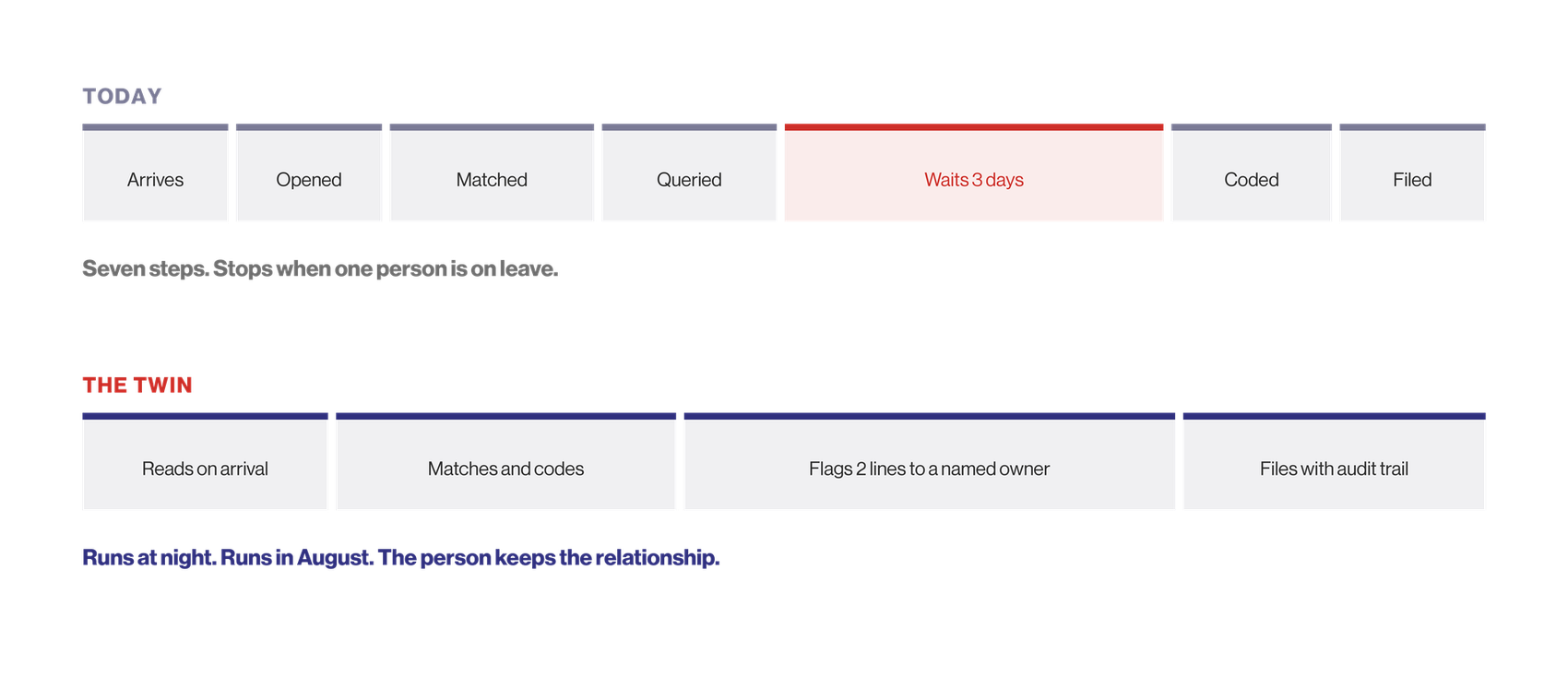
Seven steps. Stops when one person is on leave.
Runs at night. Runs in August. The person keeps the relationship.
Every business pays invoices. Seven steps today, and it stops when one person is on leave.
Four moves. In that order, every time.
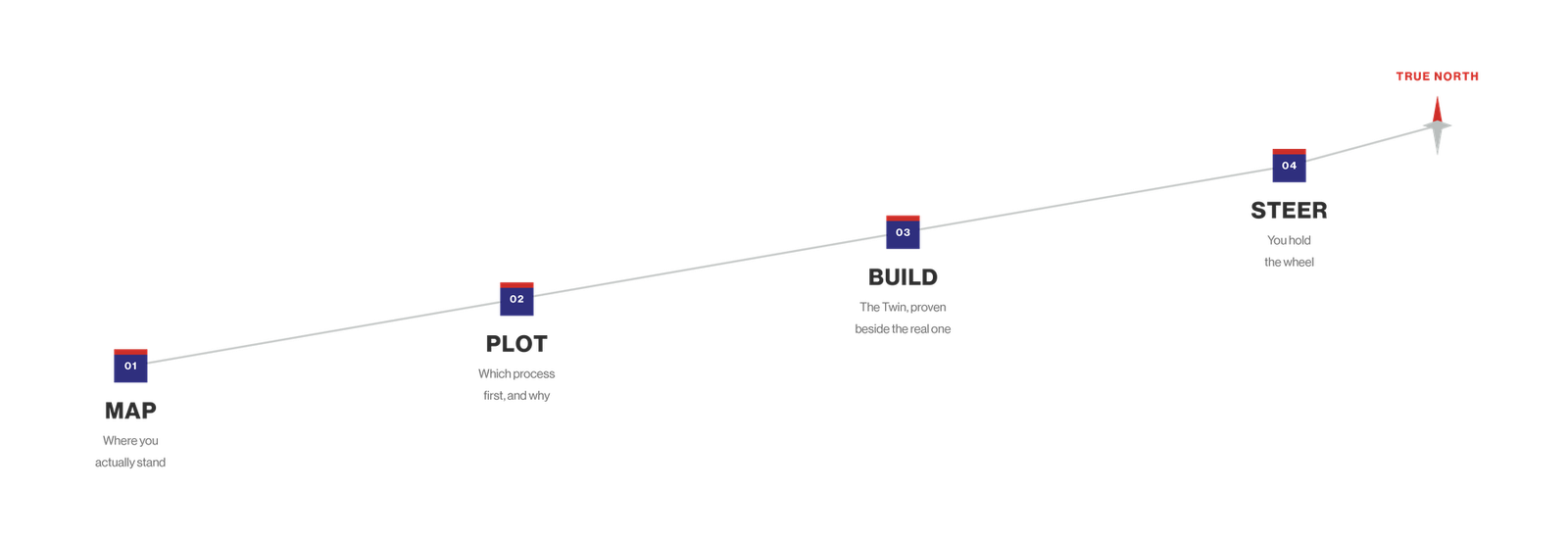
Where you actually stand
Which process first, and why
The Twin, proven beside the real one
You hold the wheel
Map
Where you actually stand. Your processes described, and a score against the eight.
Plot
Which process first, which second, and why. Including where an agent is a poor fit.
Build
The Twin of one process, proven beside the real one, then the work moves across.
Steer
The COMPASS OS keeps measuring and commissions what is needed next. You hold the wheel.
Functions get scored. Processes get built. Nobody can build a Twin of finance; accounts receivable is something you can build this month.
A compass rose has eight points.
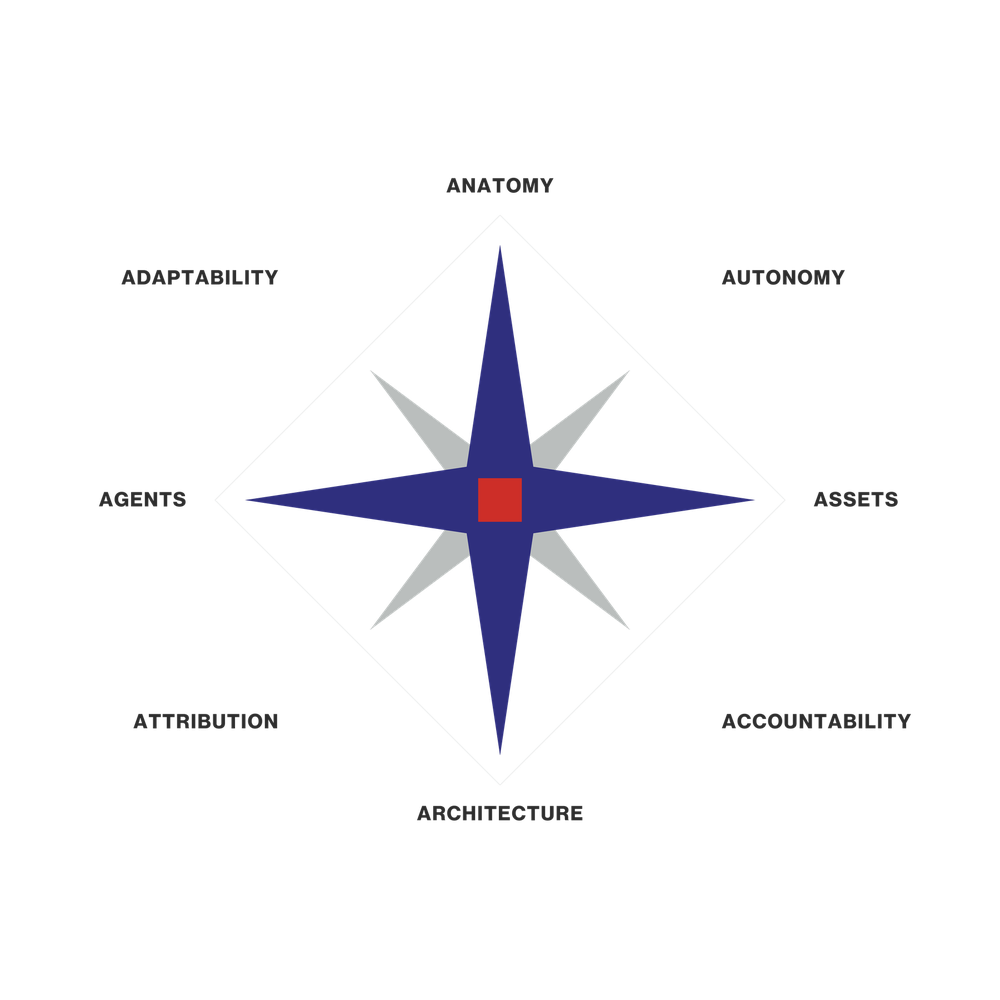
The four cardinals — what a function is made of
- Anatomy — What the work actually is. The steps, in order, written down.
- Assets — The data and knowledge it runs on, and whether it can be used.
- Architecture — The systems it touches, and whether they talk to each other.
- Agents — Who does the work today, human and AI, and what each one owns.
The four ordinals — how it behaves
- Autonomy — How much runs and decides without a person involved.
- Accountability — Who answers for it. Ownership, decision rights, audit.
- Attribution — Whether you can prove what it produced, and what it was worth.
- Adaptability — How fast this can actually change when it needs to.
A dimension that only works for marketing is not a dimension, it is a preference.
Five stages. Per function, not per company.
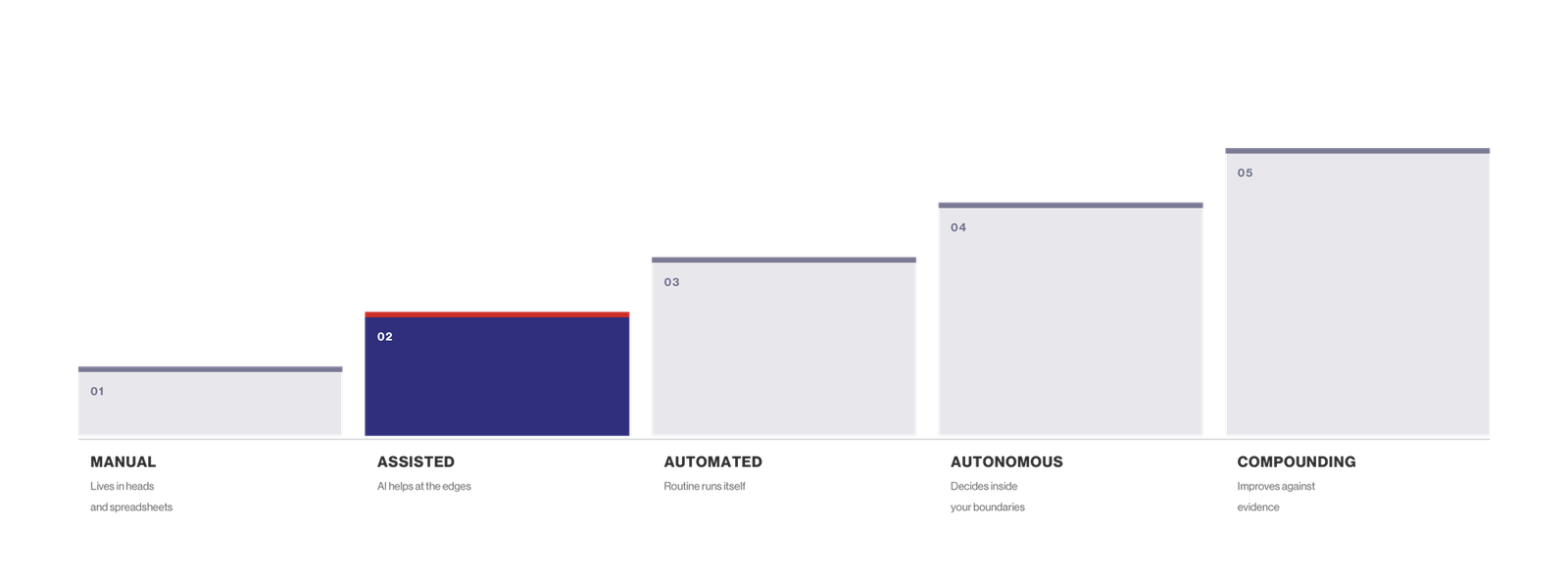
Lives in heads and spreadsheets
AI helps at the edges
Routine runs itself
Decides inside your boundaries
Improves against evidence
Your company is not one number. It is a portfolio of functions, each at its own stage, and inside each a set of processes at different stages again. Compounding means it improves against evidence, reviewed by the person who owns it. Nothing improves unwatched.
This is what a reading looks like.
- ANATOMY2.1
- ASSETS3.2
- ARCHITECTURE1.9
- AGENTS2.8
- AUTONOMY1.4
- ACCOUNTABILITY2.6
- ATTRIBUTION1.2
- ADAPTABILITY3.4
The shape is the finding.
A balanced business makes an even star. Most do not, and the gaps are the point.
The lowest score is where the work starts.
If you cannot prove what your work is worth, automating it just industrialises the mess.
You get an order, not a list.
Which process first, what it is worth, and what it would cost to rebuild.
Illustrative example.
Eight minutes. An honest reading.
You pick one part of your business. Sixteen questions about how that part actually runs. At the end you get where it sits on the curve, what is most likely holding it there, and what a Map would look at first.
Three rebuilds of our own.
Episode publishing copy
Title, description, tags, audio copy, Shorts hooks, trailer and the LinkedIn post.
8 hours by hand. Now 1 to 2. About 0x.
The daily AI Digest
Mining the feeds, choosing what matters, writing and designing the day's read.
4 hours by hand. Now 10 minutes. About 0x.
A client website
Design, build, tracking and integrations. Quoted at £3,000 and two months.
Built in 3 days. Runs on 5 minutes a day.
Three processes. Three completely different multipliers. That is exactly why we map before we build.
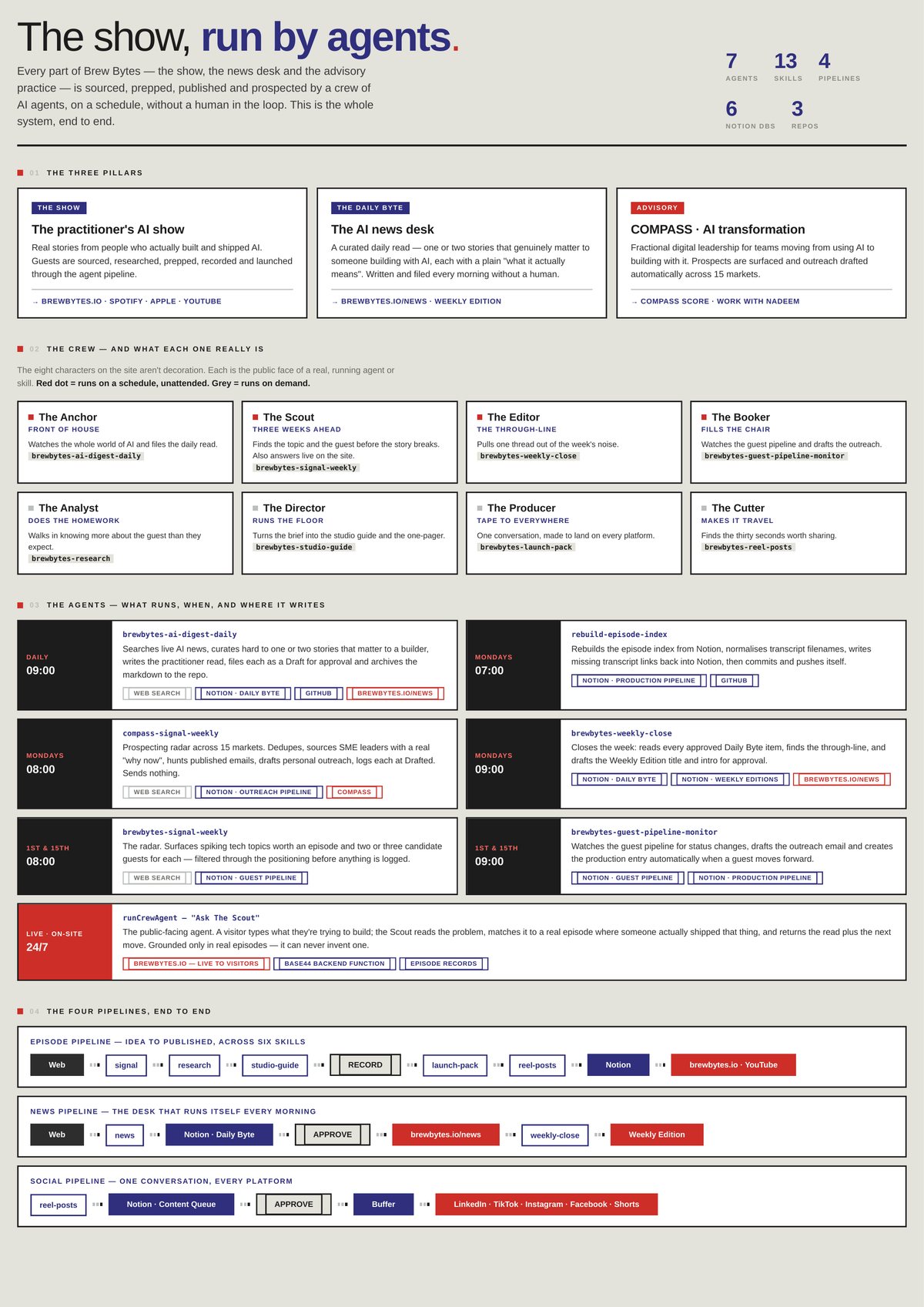
Our own operation. Seven agents, thirteen skills, four pipelines.
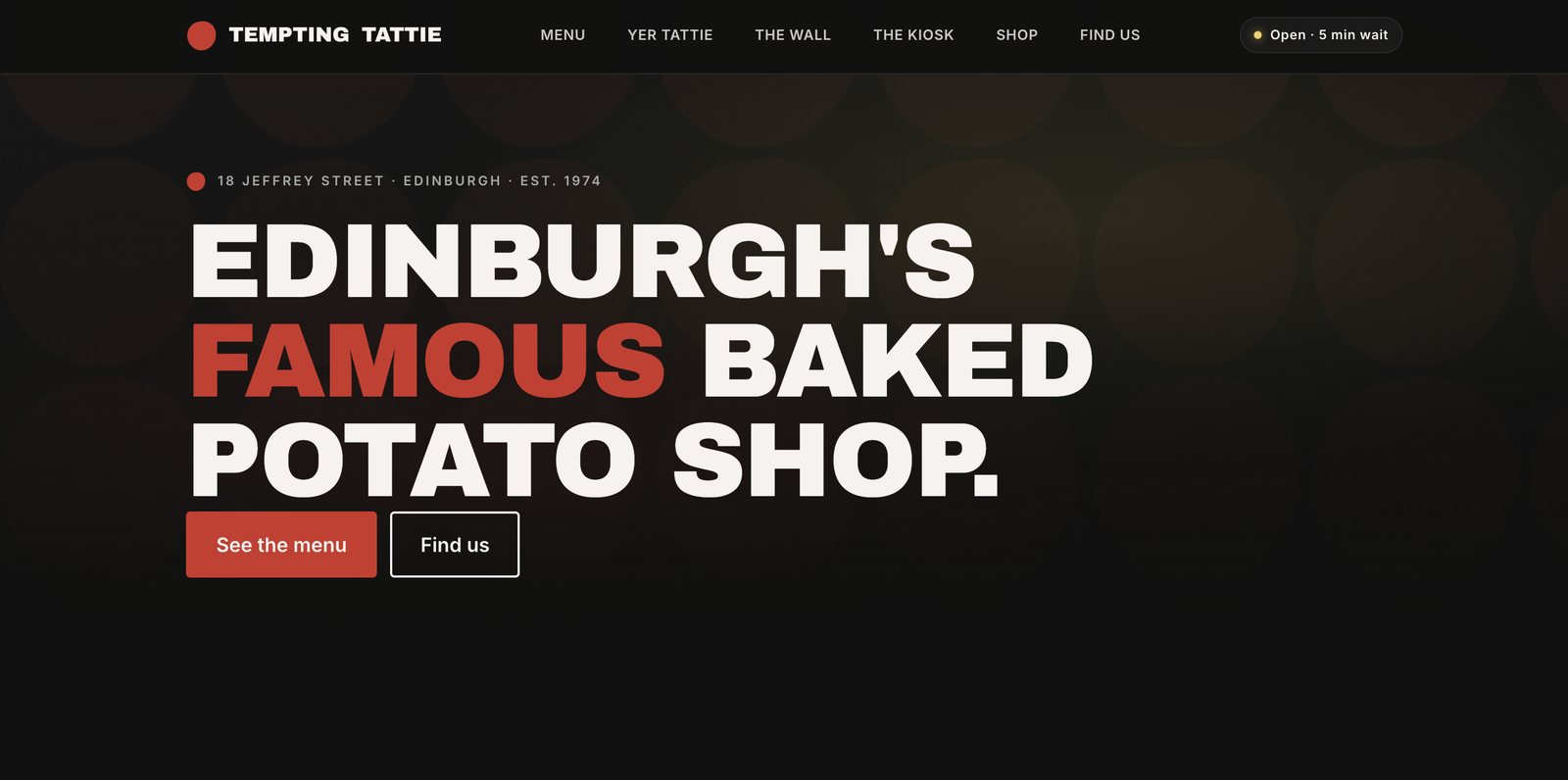
Tempting Tattie, Edinburgh. Live.
You never bet the business.
We build the next version beside the one you are running, prove it against the truth, and only then move the work across.
We replace process, not people.
You get the operation a company ten times your size takes for granted. These are the jobs you could never afford, not the ones you are cutting.
Every agent has a human owner.
A name, a role, and somebody who answers for it. If nobody owns it, we do not ship it.
Anything hired can be retired.
Your Twin runs on your systems and your data, so what it learned stays with you on the day you decide to stop.
Map one function.
From £2,500 · one function · two to three weeks · half credited against your first Build
- Two or three conversations with you
- Your processes, described
- A score against the eight
- The order to work in
- What the first build is worth, in hours going in and hours coming out
- What that build would cost
Find out where you actually stand, and what the first rebuild is worth, before you commit to anything. Then decide.
Nobody is asking you to leap.
Map one function. Then decide.
COMPASS is a Brew Bytes framework.