Are Companies Sleepwalking Into the AI Era?.
Tony Evans spent 13 years at Meta building AI-powered data teams, then went back to university to study psychology — because he realised the problem was never the data, it was always the people. A powerful conversation on what it takes to lead through the AI revolution and why most organisations are dangerously behind.
In this episode.
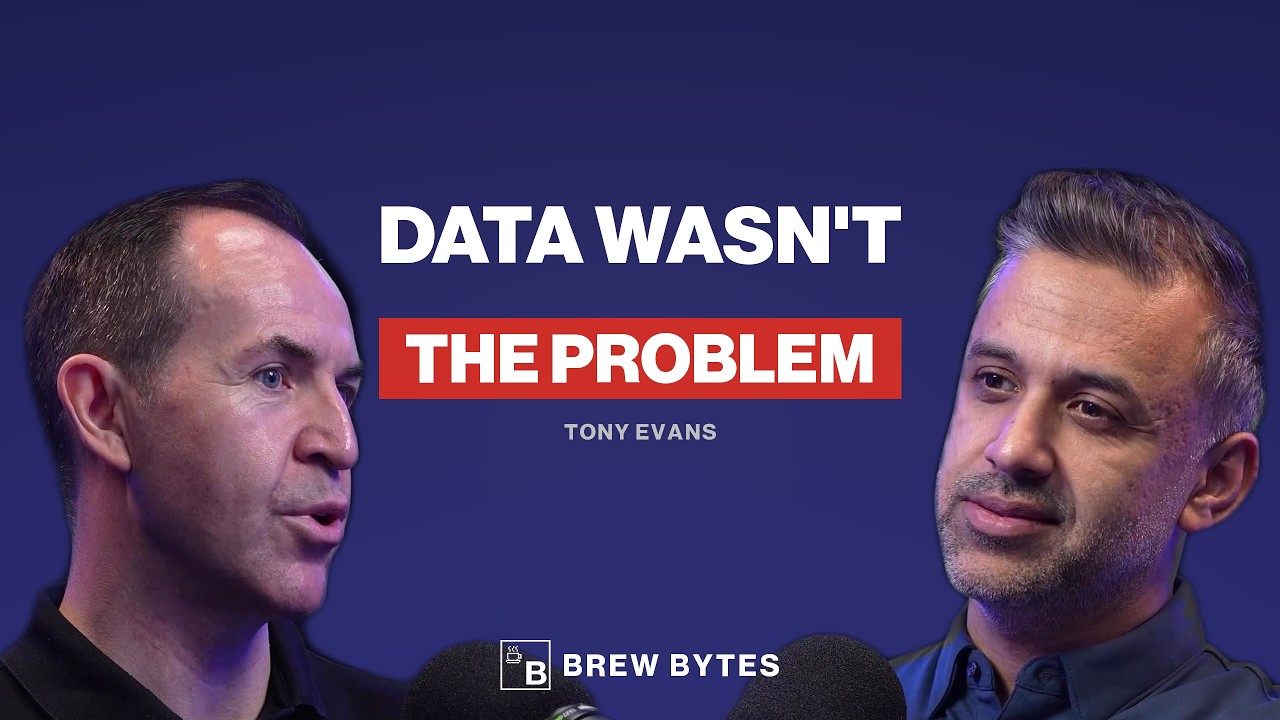
Author of Generation AI and former Meta data leader Tony Evans joins Nadeem Ibrahim to unpack the Four S's of data sophistication, the Four I's of AI integration, and why the Cambridge-Oxford Boat Race principle will define AI-era organisations.
Guest: Tony Evans. Host: Nadeem Ibrahim.
Read the full transcript
Very good example in rowing. The analysis has been done of the Cambridge Oxford boat race. And do you get your best eight people in your boat, or do you get the eight best people in the boat? So, eight people who are best individually, or the eight people who are best as a team? And I believe that we'll move to this time within companies that it is the combination of people that we'll understand better that provides the best output. Where we're not thinking about individually how we're measured and motivated, we're thinking about how the team is measured and motivated. So, to relate that back to machines, will machines be able to replace that? No, I don't think they will. I think that we will see a time and we'll enter a time where if you break down how human computers can interact, you can have what we have at the moment, a command and control from humans. Humans here, computers at the end will be informed by the decision that a computer kind of outputs will decide As-salamu alaykum, everybody. Today, our
conversation's going to take us through many journeys. Journeys that probably are on your radar, whether you're a young guy trying to figure out what does the future mean for him, or you're a leader, and you're trying to figure out what do I need to do in my organization. Today, we're talking about tech ethics, AI, what does that actually mean in your institution, and also how does that cut through the generation that we see today, right? Different generations.
today, I'm joined by someone, and I need to sort of read this because I'm quite impressed with what he has to say, and it's quite impressive. He's globally experienced executive, human-centric leadership advocate. He has also written a book, A Generation AI, leading people and machine. He also is going to share some real-life stories and give practical tips of what this actually means. And he's been his region for quite some time. Tony Evans, welcome to the show. How are you? What a flattering introduction. Thank you. Thank you so much. Yeah, I'm a fan of the show, so it's an absolute pleasure to be on. Well, thank you for coming on, first of all, and it's a it's really a pleasure to have you on here. Tony, you've clearly been in the space of analytics and data for quite some time, right? That You've written a book about Generation AI. And it's very interesting from the elements that I've that you've been good
enough to share with me. What sparked that? The last job, so my career has taken me through agencies, like advertising agencies, media agencies. And there it's always been, as you say, like analytics, helping people understand how adverts work, using data to do that. And so, data's progressed over the time that I've been in the industry. In my last job, I spent a bunch of time at Meta. and at Meta, our job was like using data and building teams, using AI as well, to help advertisers really understand how they can maximize the benefit of their ads, you know? How do I compare one form of advertising to another? And how do I get better at this particular form of advertising? And all of that is using data. While I was there, at Meta, I spent 13 years there, working with one of the data scientists in the team, lady called Kate Manogue. And Kate and I were looking at some of the challenges of our clients not really adapting to the information that was at their fingertips. And that was a real
penny-drop moment. And Kate had this framework of four S's, we called it. And she talked about how clients would move from a data point of view from like no sophistication at all, the way through to being super sophisticated. And everyone wants to be at the top of the data sophistication ladder. Most people think they actually are. I want to do some machine learning. I want to get some of that AI, without realizing that it's a pyramid. And underneath that, if you don't have everything stacked in the right way, if you don't have your data warehouse correctly, if you don't have agreement over what it should be called, how it's labeled, all of those things, like you can't actually get to the top of that pinnacle. Or if you do, you're doing machine learning on some pretty useless data. So, anyway, we talked about that for a long time about like these four stages. And we would help clients kind of go through these stages or identify where they were and
what they needed to do to prepare for the next stage so they could use their data more effectively. My realization was though that when these things go wrong, it was never to do with the data itself. It was actually to do with the people. The people who are around it and so people are not good at change. Like we are as humans, we don't like change. We protect ourselves from it. It's a very natural thing to do, right? Like as a survival technique. And so we're not being helped to change through things and past couple of decades of digital transformation that didn't really work in a lot of instances have showed us that it takes us a lot longer than it actually should. And so I think that was the moment for me of realizing that people needed to change not the process, not the data itself. And so I went back to university. it was in during the pandemic that I first started doing that to study psychology and looked at business psychology, the psychology of people, how teams are formed, like how
we're motivated, how leadership works, all of those things I wish I'd known years before. And that really helped me to get this idea for it's the people that can change and will be better if we do change them around data. And so that's led to the AI moment. And as you mentioned the book, it's helped me a lot to working with leaders, listening to leaders over a long period of time, it's helped me a lot to see how do you help people through this change? Nice. Was there anything that surprised you while writing your book? Answer. Not in the writing of it. I think the bit that surprised me is that during this period of time everything's moved so quickly and the amount of people are still sleepwalking into this time of AI and thinking that nothing's changing or that they don't need to do anything about it. That's still a massive surprise, right? There's corporations who could be doing a lot more and they think they're doing enough because I've given some people access to
some gen AI and there's so much opportunity out there and I think in a few years time there's going to be a rude awakening for a lot of people who realized that they have just sleepwalked into this period and someone else has come along and eaten in lunch. So that's been the surprising thing. The amount of free information, free courses that are out there that people aren't taking as to change. It There's a huge amount, right? And it's all moving so quickly and it's difficult to keep up.
But, I'm just amazed that people aren't doing more to learn and not doing more to help their teams to learn. Yeah. I mean, something I've been harping on about in the last couple of episodes. I was on in someone else's show and what I'm saying, the perception is AI is going to free time for you or free time for your business. If I've got that time that's been freed up for me, why am I What am I doing with that time? First of all, okay? So, AI is probably giving me 30% more time, for example.
I've got more time. Instead, I'm still doing or entertaining other behaviors that I have. So, maybe I'll keep going on my phone, I'll spend more time on social, I might just watch another episode on you know, Netflix or something. Like, I've got more free time to just do what I want to do. But, it's so through that, you should try to use that time to upskill yourself in what AI could be in your respective field or how it could impact you in the future. Like, the next generation that's coming, they're coming natively and born with AI. It just become natural for them. The generations that we'll talk about later, you know, we have elements of how we need to deal with AI and how we need to endorse it, how we need to adapt it, how we need to sort of play with it. You know, interesting here, that from PWC in 2024, they actually said 52% of parents feel that they're unprepared to guide their children through an AI-driven future. As parents, and you mentioned earlier about, you know, someone should sit with a Gen Z or
maybe a Gen Z should sit with maybe a millennial or a Gen X just to sort of be empowered by, you know, how do we sort of resolve this as I as first of all, I'll the household. Parents really are a bit reserved about AI and it's just this dark cloud over us. But AI has been around for as long as I could probably remember, not just from the search engine of Google when it launched, not just when the internet had launched, but even aircrafts, they've been running on AI for quite some time. I mean, there's not really someone behind in the cockpit that's actually, you know, flying the aircraft for 9 hours solid, right? You know, so there's AI that's been endorsed in there. My worry is that if parents are worried today, then what does that mean for the future for kids, you know, because they're discovering how to use AI themselves without parents being involved in that thought process. Well, then suddenly parents who are not in tech space will feel left out and be very difficult
for them to really grasp, you know, how did you do this or, you know, what do you mean you were in a lecture and now you've got something that's just helping you write all your notes? I don't quite understand that that's cheating. No, it's not cheating. It's helping me be a bit more productive with my time. So kid So parents might have lack empathy in that. They're okay, you've got more free time, but yet you're still like partying. Yet, maybe it should be, okay, now you've got free time, maybe you need to sort of think about taking on another hobby or you need to be taking on a maybe another subject matter. Like is there's not one right solution for this, right? Of course, there's You touch on a number of really interesting things, right? Like the choice first of all is one thing. The choice of what we do with our free time. I don't think that has necessarily changed. I've got the choice when I'm doing my homework if I'm
a if I'm a kid. Do I do the extra study cuz I want to get the A rather than the C? Or do I spend the time watching TV? Like that might have been a choice for my generation. do I spend time playing outside on my bike as opposed to like doing this extra work for the exams that I could do. And the choice these days is just the same. It's like, do I want to learn these additional things? And so, the time saving that AI brings, I think that's a very interesting one because it's not just a personal choice, but also a company choice. So, leaders, I think, will go in two directions on this. There's the AI is saving us time, that means less heads. I can save some money, right? The alternative is AI is saving us time, people can be more productive with the time that they've got. In which direction do we encourage people to go in? Now, I really hope it's the latter. I worry because the incentives for most CEOs are the former. They're aligned with the former. They will see people
going down the route of like, "Well, I just don't need as many people as I used to." And I feel that's a real shame. We've seen that today, though. It That That's starting to happen. I personally think I think it's a bit of a pendulum, and I think it will swing back again. Cuz I think if you look at what we get from people in the workforce in a couple of years' time, you haven't hired five of those grads, and now all of a sudden, like, who's ready to move up to the next stage because people have left, and we haven't got the people. We realize, "Oh, we made a mistake of not having those grads a few years ago." So, I do think it's a bit of a pendulum. We are starting to see that, and it's a bit depressing that we see that that's happening instead of maximizing the work that people can actually do with AI. So, I think the AI maximization is certainly be something that I advocate for. If people can be disciplined enough with themselves to
say, "Well, I've got 30% extra time, what should I do?" the level I think the other thing that it reminds me of is that the level of knowledge that we have on certain things. There's We're starting to see a lot more research about this that not understanding a subject as much as actually different in the new ones in our brain. If I use ChatGPT to write an essay as opposed to learn and write it myself, I'm actually using less neurons. Now, that doesn't sound good to me, right? Like, I don't understand the area of neuroscience well enough to know what what's the long-term impact of that. But, it doesn't sound like it's going to be a good thing for critical thinking in my assessment of things over time. So, is that 30% of my time spent better invested in let's read the books that are out there, the knowledge that's actually out there on a number of different subjects cuz that makes me better armed for the future. So, I want to be a better manager. I go
out there and I'll read some management books, right? Like, whatever it's going to be, I've saved some time, I'm going to use it as opposed to just like I'm going to go on I'm going to go on social media and like use the chewing gum for the brain for the next half hour. I mean, that's interesting. you know, like I don't think people are using their time wisely enough. And organizations are going through this cull, you know, of cost savings. And is there going to be a pendulum? I don't know. I just think it's just going to be get worse and worse. Already, unfortunately, we've seen people suffer across different organizations who've been affected because things have become a lot more automated. AI, but even before AI, just the fact that you were able to automate something resulted in a cost efficiency exercise by a lot of CEOs, for example. How do I increase my profitability while driving more efficiencies? But productivity is going to take a
hammering on that at some point. Can empathy skill in a world of efficiency? The less humans you have involved in a process, the less empathy there's going to be. Yeah. and I personally believe that what we can achieve as teams of people harnessing technology at the same time is way more powerful than computers be able to achieve on their own. If you look at any of the AI companies that are out there at the moment, any of the big companies that are using AI, like none of them are doing it without people, right? And it And it's a combination of smart people motivated in the right way using machines in the right way. There is a combination of both of those things that has to happen. So, to the question of empathy, how do you motivate those people in the team if you're not empathetic? Like, it's just not possible, right? How do you keep those people motivated to work for you rather than for someone else? I do think that people both entering the workplace and
those who are in the workplace at the moment, they want a certain level of interaction with other people in the company in order to you things done. Now, there are degrees for which you need that. You could argue within certain companies, but people don't want to spend their time. And bear in mind, like we spend more time in our companies than we do with anyone else in our lives. More time with the people. It's as much of social important thing as it is like the actual output of the achievement of what we're actually doing. And so, that connection for people I think is going to be still of fundamental importance. We will still come together as humans to form certain things. And if we make it really dull, people are just aren't going to want to show up to the That's So, interesting you say that. There's like There's many opinions when it comes to machines or robots that precedes in humans. There's also the opinion that, you know, you'll still need humans
regardless of what the technology is sort of, you know, developing in some respect. what human traits do you think will be safeguarded as, you know, machines or robots, AI sort of starts to become more and more powerful. There's got to be some human traits that will still be relevant, right? To- totally. The And how to engage with each other as a team of different skills will be one of them. I don't think the computers will be at the stage of understanding where different levels of skills are between themselves, for instance, you know, it don't doesn't sound like it's something the computers will figure out. And so, the understanding of different traits that we all have, how we're complementary to each other. If we break that down into sports for argument's sake, you know, if you think about certain team sports, you don't have all the same people who are the same size and shape doing the team sport. you also don't always have just the best people. So,
there's a very good example in rowing. The analysis has been done of the Cambridge Oxford boat race. And do you get your best eight people in your boat, or do you get the eight best people in the boat? So, eight people who are best individually, or the eight people who work best as a team? And I believe that we'll move to this time within companies that it is the combination of people that we'll understand better that provides the best output where we're not thinking about individually how we measured and motivated, we're thinking about how the team is measured and motivated. So, to relate that back to machines, will machines be able to replace that? No, I don't think they will. I think that we will see a time and we'll enter a time where if you break down how human computers can interact, you can have what we have at the moment, a commander control from humans. Humans here, computers at the end will be informed by the decision that a computer kind of outputs, will
decide what do with the data. We'll move to a time where you've possibly got the time of computers saying this is the decision you need to make and the humans implement it. There is the possibility that computers decide and computers implement, but I don't think that will happen because without the context of the organization and without the history, which is what humans have got in spades, this stuff becomes very, difficult to do. You might be able to get a computer trained in the right way, some AI to say, "This is the decision to make right now for the year." But we are notoriously bad in every industry at actually using data to forecast accurately. It's difficult today. Yeah, you've got me thinking about that race now. You know, going through Fulham and Wandsworth back in my days to watch that I watched it was every Yeah, every year it used to happen. Anyway, I digress on that. In your book, you write about Gen Zs and Gen Alphas entering to a world where
it's all about automation and algorithmic biasness, right? How should all the generations keep up with that without feeling irrelevant? I think if you're from the older generation, then getting to the speed where the younger generation are on AI is an uphill task. It's a very difficult thing to do. We're better off as older people focusing on the skills that we've actually got that we bring to the workplace, we bring to our lives instead. So, if I give the example of playing computer games with my son, back to the question on computer games, like it was probably 10 or 11 when he could beat me at most games. Like, if there's a Call of Duty or something like that, his reactions are so quick. Like my brain doesn't fire in the same way as his does cuz it's older, right? And so you realize that there's no point me trying to get my brain to work quick enough to beat my son at Call of Duty. Take us to a game of chess where we can play in strategy and play over a longer
period of time and I would hands down because cuz I had the advantage of crystallized knowledge over time of how that game works. Although, sorry before I'm going to cut you in just going to say a little bit here. Although I think what my godson, okay, is I'm sure he can outperform you and he's only maybe six or seven. In chess? I'm not surprised. I'm not the best player. Yeah, but he's based in Dubai. We'll get him to sit with you and I'll be up here. He'll embarrass me, I'm sure. So I think with my son it's just a difference in the two games. He's got no patience to learn the game of chess in the way that I learned it and so can he play chess? Yes. Can he play chess to the degree of thinking as far ahead as you need to? No. And so there's that crystallized knowledge which is different and so I think that exists within our lives and within the workplace certainly. If you look at older people who are in the workforce
and so if we take the example of baby boomers, are controlling most boards in the world at the moment still. And they have a level of context to the business and they have a level of crystallized knowledge and a risk averseness that comes with many years of experience and you don't have that as you enter the workplace and there's advantages and disadvantages to both. The real secret I think for leaders in the future is how do you blend both of those together? How do you get the Gen Z'ers working with the baby boomers cuz those guys don't see eye to eye. So what do you think you know, each generation what do you think they misunderstand with each other? There's got to be misunderstanding. The if I take the generational look from the older people to the younger people, some of the time we hear the phrase of people being like less interested in working hard for the Gen Z'ers and I don't think that's necessarily true. I think that my
experience has been talking to a lot of Gen Z and doing the research for the book. They actually want something different from the workplace for a very good reason. So, I referred to having a Gen Z mentor right here on. He comes up in the book several times, Nick. Nick is smart, right? Like Nick has just finished his masters in neuroscience at UCL. He's entering the workplace and he wants something very different, not because he's lazy, because he looks at my generation, his father's generation and being like, "So, you guys like you work for the same company for all this period of time and you're so burnt out and disengaged with all these things. You do nothing for yourself. Like, why would you do this?" And so, I could interpret that as being you don't want to work hard. It's like, "No, like I want to have this balance where I can do the things that are important in my life. I could see that for your generation you got the reward of doing that. Now, I'm not going to get a house
in the next 10 years with the best job, right? So, why would I do this? Why would I put myself through it? So, I think that's a misunderstanding of the younger generation of what they want. He said something very interesting to me about gym membership. And so, he said to me like, "You know, the things I'd look for in a job when I enter the workplace, gym membership." And I was like, "Why is that?" Thinking to myself that's a financial advantage. So, I want to save myself some money on the gym. He's like, "Because if a company cares enough about my mental health and my body and my well-being to pay for a membership, they clearly care. And that's what I want in a company. I want a company that cares for me." So, I think that's the misapprehension that we have about the younger generation by not really engaging and talking to them enough. The misapprehension for the young people looking at the old is that the skills are not are out of date and knowledge
they have is out of date. And I think that is actually totally incorrect. It's the context that a few gray hairs give you that makes you more patient, more risk-averse in the right way with AI. So, to give an example like for anyone who's felt the embarrassment of having a figure wrong in a presentation, you're presenting to a board and your figures are wrong. Like, if you've ever felt that pain, you'll never do it again, right? You'll make sure you do the research to the nth degree because that's not something you ever want to do again. Whereas, the younger person who is like doesn't has never felt that pain may just pull some figures from ChatGPT and think, "Well, this is going to be okay." Well, do you think it's because maybe older generations are feeling sort of digital native institution? I think it's because they've seen it go wrong like too many times. They've seen they understand the Like what?
machine can hallucinate. They've understood the figures are wrong. You know, they So, as an example, like using ChatGPT just this morning as I'm preparing some stuff and I know it's got a figure wrong. I'm asking you what percentage of the workforce now is Gen Z projecting forward for the future to 2030, what percentage of the workforce is going to be Gen Z? It gives me the same figure for both and it's like, "Well, how can that possibly happen?" If I didn't know to read through this and think to myself, "That's a pretty simple calculation." Yeah. It can't be the same now as it is in 5 years time and then challenge the GPT on that. I wouldn't have I would have given the wrong figure. and so, like it's that kind of thing that an older person I think knows to do and having those critical thinking skills to be able to realize AI is a tool, it's not the Bible, it's not like it's not something that is
completely gospel truth. But, do you think this. I'm on the fence a little bit, Tony, cuz there was something by Accenture I just got a note here, actually. It And their research claims that 69% of Gen Z's trust AI. 31% of baby boomers don't. Now, you mentioned a lot of board of a lot of organizations are still baby boomers. Do you think the fact that Gen Z's have a lot more trust in technology that tool on AI. that that's the reasons why we were sealing seeing blue chip companies become multi-billion dollar companies so quickly. And we're seeing the decay you know, of some of the bigger brands out there. You take Kodak for example many years back. You take Nike losing market share to on running as another example. You know, you look at the Emirates in this region doing a fantastic job of how they are optimizing air travel and comfort and experience versus what you might see with British Airways for example. When we talk about it, but it's night and day.
I'll just purely like just that You say that's a myth or that's a real It's a reality, right? Like Gen Z's who are adopting technology that are up their own businesses are becoming are growing much faster while older organizations that are still being run by maybe baby boomers who are not adopting technology in the right way that's seen more of a cost saving exercise and are falling behind that race. Great. So, I definitely agree with that and I think it comes down to the investment that people make in their people in terms of keeping up. If you look at how many businesses are in the FTSE 100 from a UK point of view, the S&P 500 from a US point of view and how that figure's been different in the last 20 years. Like how many of those companies are still around? And then say you go back to the last 50 years and you'll find there's very few that are still the same. That's definitely true. The companies failed to modern modernize and they failed to keep
up and they get left behind. And I think that comes down to the teams and the investment in people. And this is very relevant to what leaders need to do with their teams for AI. how do you skill up the people that you need and make sure they're using those skills? That that's a whole process and it's a whole process of change. And if it's not done and the phrase that I like to use with the teams that I engage with from a coaching point of view is that if you're not keeping up at least with the of change, at least with that pace of change, then you're on the path to extinction. So, how do you stay ahead of what other people are doing in this space and not become the Kodak or the Blockbuster or the myriad of companies that went to the wall because they refused to see that these things were changing. Now, the Gen Z's in this, how important is it? Listening to the Gen Z's in the company, finding a way of not saying, "I know best cuz I've got 30 years of experience, but I know better
because I'm informed by young people who can see some of these trends that are going on." But you can still see you can see, I mean, a little bit off topic. Some organizations that I know of, been part of, whatever, Gen Z's can be quite a frustrating generation to have to deal with versus what has been so long the status quo of how you sort of run your, you know, run your workforce. What I mean by that is they're more emotionally driven in some respects, okay? You mentioned this whole balance of what value Someone said to me, Asif Hussein on our previous show, talk about Gen Z's, what they look for purpose. They look for a lot of purpose. So, what purpose? And I guess it goes back to your point about the car. Highly depreciated depreciating assets. What purpose has it got for me where I can make more money? Very different outlook to things to what we have, right? and it's just interesting to see how, you know, leaders are not necessarily acknowledging that in their piece of
work. You actually say in your book that AI will redefine leadership. I still think that. Our gen my generation, your son's generation are guinea pigs when it comes to AI. I'm not because it's still being seeded in and different generations are picking up on AI for different reasons, and different generations see it in a very different way. You look at the school kid versus the student versus the guy who's been working in an organization for 20 years and he's having to adopt it now or his job is under threat so he needs to sort of diversify his skill set. What should the future leader be thinking to themselves? That's one thing. The next part of that question is what will the next generation leader look like? If we think about this moment in time of human evolution, right? It's a drop in the ocean of the things that we have evolved to as humans, right? So if we take human evolution of the modern human as being a few hundred thousand years old and then
probably from time when we came out of caves and started walking upright, etc. as being like a couple of million years, right? Like this moment of the last 50 years of technological evolution is a really small moment in time. And so I think we have to accept that these things will take a long time in order to do it. So it's interesting you see it as guinea pigs. That these it's definitely a time of testing, right? Like and how things will work. But the dynamics of how people come together in groups hasn't changed, right? In the last few hundred thousand years. To be part of the group, I need to provide more value than it cost to keep me in the group, otherwise I'm out of the group. It's a basic human thing that like it will take us a long, time before we get past that point, right? Like it it's going to be probably more millennia of us actually working for us to be different from that. So if you look at that human evolution, how we form groups, how we
get together with other people, how we're motivated, all of those things haven't hasn't necessarily changed. We understand that better with modern kind of management science than we have done before. And applying that management science into leadership is how I think leaders will evolve through the next period. So to answer the question, like what will leaders look like in the next phase? The smarter leaders are the ones who recognize that if I need to have these kind of skills within my organization, I've got to find a way of bringing them into the group in the right way, by motivating the right way. Purpose that you mentioned is a really good way of doing it. People want purpose, and it's not just the Gen Zers that want purpose. People want vision, they want purpose in a company. The days of transactional management like should have died in the Victorian times, went on until about the 1970s or 1980s before we moved into a transformational time. But, there are
still people who believe that transaction, as in I pay you do a job and you're just going to do what you're told and then you go home at the end of the day is enough, and it's not, and it's definitely not enough for the next generation. So, the leader of the future needs to recognize that, and I believe needs to employ more psychological understanding of teams, of team motivation, of individual motivation, if you're going to get the best out of people, because the days of command and control, whether it's machines or whether it's people, have just disappeared. and most leaders will know, like and I'm sure you know yourself, like people just don't do what they're told, right? They don't want to. Why would they? And so, They want the flexibility, they want to work on their own terms. They want, you know, work from home, which is another big thing for Gen Zers. And I understand why for them. And I
think that we'll all have to make the decision. Like I'm old school in the respect that I like being in the same space as people, I like doing things face-to-face. I get much more understanding of people when I'm in the same space than I do through a screen. But, I also understand that somebody who was during the pandemic, that was their first experience of work, they're like, "Well, we seem to do this quite well through screen, so why would we not?" But, let's dig deeper a bit.
Like skills. It's interesting to think that we've all got different skills. And you mentioned older generation should probably like not stress themselves too much about AI. Because they're not born to be in that you know? I think they should stress themselves about AI. Because they don't get me wrong. I What I'm saying about that is that to try and learn as much AI as somebody who's been using it natively for the past 5 10 years is an uphill task, right? Should you learn about AI if you're older? Absolutely, right? You cannot afford to just put it to the side and say it doesn't matter. So, what skills then do managers need to be thinking about then? Let's like really go into it a bit more and be a bit more specific. You know, it'd be great to really understand what are the sources cuz all I've been hearing, not from you by the way, Okay. through different events, what really frustrates me about, you know, the industry of tech,
we we're very like we're very glossy and very like big about not going to take your jobs and, you know, we've you know, we just need to learn AI. Now, but just go into some of those skills because we have to acknowledge and endorse Gen Zs. Gen Zs are the future human capital of what whether we like it or not and Gen Alphas. And today, if you've got baby boomers or, you know, Gen yeah, baby boomers and Gen X on, you know, making big decisions for big organizations, right?
That eventually they're going to be superseded by these, you know, the new generation that's coming through of AI. Why? Because they'll be able to have a storyline to say, "Look, we don't need to sort of look at a cost-saving exercise anymore. We can look at more productivity, more revenue, maybe increase our market share, and we'll have we'll be able to increase brand equity by whatever it might be because we're able to use tools in a better way. And by the way, we might be able to retain as many humans as we can in our organization because they're going to add even more value through 1 2 3." So, if I'm a leader today and I'm just thinking, "I'm just going to save some costs or I'm going to write a menu of my for my restaurant. I'm going to use AI." Doesn't really do much, right? What are the skills that they should be thinking about? There's a few answers to that, and I
agree that people are very woolly in this area about what are the skills they actually need. I think some of it is keeping up, which is difficult. There are so many things in AI that you could learn. I personally think applying the context of your business using AI is the most important thing you can do. So, starting with the question of what do we actually want a computer to do for us that a human otherwise couldn't do? How does it assist us in this area first of all? Helps us to understand the skills that we need to build. I've got a framework in the book, the four eyes of digital of I've got a framework in the book, the four eyes of AI integration. And I talked through the different stages that people and companies will need to go through in order to use AI more effectively. Being intrigued by AI, using a GPT to do some work to produce a piece of creative is just the first stage. If you actually want to use data in an effective way to make decisions more accurately within your business
than you can do it at the moment, then that requires a level of understanding how data needs to be structured, which is the kind of the second and the third stage of AI. How do I learn about data structure? Do I hire people to do that? Or do I start to understand myself? Well, this is how data structure actually works. This is how data is warehoused. This is how APIs can be used to get at that data. This is how decisions can be made around it. And so, I think that more of the understanding of prompting for the first stage is really important. Like, getting to write prompts and write good prompts. Secondly, is actually understanding the infrastructure of data and how data works. How does it get from one place to another? I think the third stage in the application and becoming intelligent about how you do it is much more about the context of the business and applying that. So, as a manager, I need some understanding of how data moves from one place to another and how it's stored. I also need the context of what the
business question is. And then I've got to understand does everyone talk the same language when they're using data? One of the worst things that happens with data and it happens all the time is people just fight over whose data is correct, right? So, I've got my data like this and I'm going to say that my data's correct. She's got her data like this and she's going to say her data's correct. And we end up in meetings just arguing over my data says this. And so, like the manager needs to be able to like how do I reconcile that conversation? How do I reconcile that? And so, that blend of organizational context blended with some skills of understanding how these things work. And then, I think the last piece of this is how do you motivate people to work in the right way? You're going to need some smart people who if you don't let you want to learn data architecture, you need people to do this stuff. How do you relate to data scientists? Like data
scientists are and engineers they're differently wired in terms of their motivations than a sales person. And if you try and treat both of them the same, I've worked with data scientists in the past and I could say to them like would you like a bonus or would you like to work on an edge case? They're like, I'll work on the edge case. That's far more interesting, right? And so, those kind of things, understanding the motivation of people within your team is going to be the really important thing for managers in the future. On managers, now if I can just say a little more on this subject, I'm passionate about this particularly. I'm still amazed how little investment we make in managers. Not the region, just generally. Most people like myself, if you ask people of my age and I've been in jobs, I've been managing people for like 20 25 years. Like the only official manager training I've had, any official manager training, is maybe a two-day course that
I did like 25 years ago, right? And yet, I'm let loose on a group of people and I have such an impact not just on their work life, but on their personal life as well. We need to far better with managers to help them through this phase. I wish when I studied psychology, I wish someone had helped me like 25 years ago to understand this is how people are motivated, this is how teams are formed. This is the impact of national culture on that, this is the impact of age on that. All of these things, these are the different techniques of leadership. All of these things would have been super valuable and avoided me making a bunch of mistakes over the 25 years of managing. My well, that's a lot. I'm digesting. And I've got a lot to ask off the back of this now because Kudos not when you talk about understanding different types of data, understanding, you know, architecture of data and stuff. You're referring to just to be clear, for every anyone who's listening and watching, not necessarily
for everyone, mainly leaders to really have a better understanding so they would be able to make better decisions about, you know, something that might impact their business with the use of technology. It doesn't mean if you're coming into an organization but we're saying that you need to understand from the root of data upwards, for example, right? It's more about for managers need to upskill themselves in those specific disciplines, yeah? Totally. So, you don't want to be a data architect. So, but understanding that process and so you understand and no, you can't understand it deeply, but you can understand the person who is responsible for that within your business, whether when he says this job is going to take 3 months and can be done, whether it's accurate or not. I do see a lot of leaders making the mistake of thinking that AI is some sort of magic, it's not, right? Like it is a tool that we could use. Yes, it's incredibly powerful, but it doesn't you can't just
wave the magic wand and like it everything goes away, right? Like it still has to be used in a particular way and it's all based on data. If your data is not cleaned, if your data is not stored in the right way, if you can't get at the data, if it's mislabeled, like none of this stuff works. But then, do you not find because the rapid pace that AI is sort of been instilled in society and, you know, and that impacts businesses and how we live our lives, right? At that rate it's quite difficult for a general manager or a CEO or even a CTO to really get their head around this so quickly. So they're having to rely on their own instinct more so right now cuz it's going to take them quite some time to sort of upskill themselves and it's too like either you understand it or you know it. If you know it, it's a bit more passive. Guys, understand it, then you have even better empathy around the decisions that, you know, your workforce are asking you to make.
So, do you not think it's just more of the fact that we've been outpaced by technology right now? I think it comes back to teams, as we're talking about earlier on. The different strengths that we to bear to answer the problems that the organization has. I truly believe that that's the secret. It's a combination of everything. And instead of being able to do this and address those problems together, we try and learn everything. So, a leader can a leader learn everything?
No, absolutely not. It's not possible. Can we connect together better as a team to work out where do we want to go? What is it that we need to get ahead of to make sure that we are learning in the right way? And who's got responsibility for each bit? That's a bit that I don't think teams are doing well at all at the moment. And so, that's taken me into the path personally of coaching teams for that moment and particularly practicing for those moments. So, if you think about a high-performing sports team, for argument's sake, I can't imagine like a Man United or a Liverpool to take it to, you know, to take it to UK football. or you know, Paris Saint-Germain. I can't imagine any of these guys not practicing in advance of the big game, right? Like just doing their play on the pitch instead of getting together, working out where are weaknesses, where are our strengths, and how are we going to play more effectively as a team. And that's something that needs to happen a lot
more these days. We don't think about the practice, right? We don't think about the practice as teams together. How we relate to each other, how dialogue works, how do we take our stakeholder views in. None of these things actually happen, and that's all practice so that we get better at doing the thing that we need to do. And in organizations we're bad at doing that. It's quite funny you say that. It's quite upsetting when you see some brands you can almost sense, actually, they're going to be a victim of their own success in some ways because of how technology is just sort of outperforming and just coming in and to my point earlier, you could be a blue chip company today and you become a multi-billion dollar company the next day. Take a look at Nike being threatened by On Running right now. On Running are just driving purely on innovation. They don't have any fancy, you know, celebrities. They're just a brand that's been known for having, you know, really good performance shoes for different,
you know, different areas of purpose. Nike, though, something that's a brand that's very close to me growing up from Converses and Jordans and stuff. Even today, my kids are just spoiled by that for me because I just love the brand. But one thing they were able to do so nicely was re- become relatable to society movements that would be taking place. Whether it was the whole One Knee thing, the Me Too movement, you know, a lot of things. And that's what a brand, pre-AI, I would say, was really good at doing. Okay? Now you have AI coming into it. You're not allowing AI to fuel your innovation. I mean, I know I'm saying something that might be, you know, out of line here, but it's an assumption I'm making. Are you letting AI really, you know, redefine your products, your services? Or are we simply just making a lot of AI digital mirrors? Now, what what's your take on that? I think if you think about those Nike moments, these huge like blockbuster ads that they would make, 60 seconds long,
etc., around certain events that feel emotion. Yeah. I cannot see a computer like being able to connect with emotion in the same way as a human using the computer can, right? So, it's a tool that a creative may be able to use to make that more effectively. But to capture that moment, what was it about the one knee cap and it that Yeah. like was such a thing. It was a moment in time for a number of things happening in that society. And is a computer able to recognize those in advance night? Computers are nowhere near our brains in terms of humans and human intelligence. Like nowhere near and won't be. There's a lot of people predicting when AGI if that if that's a thing is going to happen. Like will it be as complex as our thinking processes and emotions, etc. No, not even close to it within our lifetimes. And I don't think even probably our children's lifetimes will it be as close to the complexity that we have within our brains to be able to
operate the way that we do. Emotion will be the thing that we very difficult, I believe, for computers to do. You know, so I still see it as a tool. It's a very powerful tool. It can enhance a lot of things for us, but it's not a replacement. It's not a replacement for emotion and being able to do that. How do we assess the data for Nike to avoid doing that? And again, coming back to the organization, what structure do we have to make sure that we don't get our lunch eaten by these guys that are younger and more nimble than us, you know? That's the thing. That's the thing. You know, and then yeah. You asked quite a powerful question. I believe it was in your book or maybe when we were speaking a few days back that you know, are we building something for the sake of building? You know, if there was one AI feature that you could pause right now that you think, you know what, this is just not needed right now. You have an idea what that would be? philosophically, yes. I mean,
philosophically weaponry. But, that's never going to happen, right? You know, that that's a If you look at some of the things that are being done with weaponry at the moment, it's horrific. and that's only going to get worse and worse, you know? So, you could argue that both ways that it's a deterrent that the more powerful these weapons get or the more accurate these weapons get. But, I think if you look at the way that wars are being fought at the moment, it's not It's scary, right? Yeah, exactly. And so, that that's something I'd love to see pause. Is that going to happen? Absolutely not. Because there's too much money involved in it. There's too much power involved in it. be in a room here right now and it's just like a almost like a computer game. My physiotherapist this morning was telling me that in China they have created drones the size of flies. Like Ant-Man from Marvel. I was And they and the collection of
data for that kind of stuff and how it's possible. Yeah, but it it's been some time now that drones have been operating in Asia that will have facial recognition and could be like, you know, flying around and it's like a sci-fi film of like I see you go home now and like some people are comfortable with that and some aren't. But like it's if you think about the misuse of that and how that could be misused if it gets into the wrong hands, it's pretty scary.
Like Yeah, I mean, I think that we take for granted we're in a region that is thriving on you know, a innovation. you know, the ministry I think in the last few weeks have sort of mandated schools to install a an AI program. You know, I I've known some lecturers in some institutions now who have had to be let go because they don't have a doctorate in AI. That's how serious this region or the UAE is taken, you know, AI and the benefits of AI that will come with. And you see that as a country that is so fixated in the best way possible to have the best future outcome for its own economy.. You see other countries who are not really instilling that same manifesto that really makes me feel me makes me a bit more unsettled on the form of that you know, as big economies today you are going to become very outdated in future if you're not instilling some form of program in institutions to get children really sort of understand and what technology is where it's going and why
AI matters most in its most simplest form. Goes back to my point of Gen Alpha should natively be born with AI per se, right? And it's great that this region is really starting to be it's sort of not really starting, already one step ahead of where AI is going to be taking us. We have seen you know, the flying the helicopters that's going to go from one to another, you know, and we have drones here, we have a bunch of stuff right here. I was at a Dubai airport last month. And so bizarre. I've been through it twice now. Head of the smart tunnels? Is this walking through for the passport? Yeah, so you don't even need to take your passport out. This is just walking and you got eight cameras and it gives you a green tick. It's So, I Yeah. If you got time Yeah. I would tell you about the visit that I made to the LA Clippers stadium like a couple of months ago. That is the most amazing technology that I've seen anywhere. so, I was
invited along with a friend who lives over there. we had a meeting there and we were shown around the stadium afterwards. None of the as you walk into the gates to go in, you don't get your phone out with your ticket once. Everything is facial recognition. And so, they have people with iPads there that if you don't get caught, then eventually you will have your face recognized. You go through the gates. Everything inside there, you don't need to get your credit card out once. You go into a concession and like if you've seen these shops, you know, there's a glass barrier you go through and by facial recognition, your card is linked to it. You pick up a hoodie, you pick up some swag or some sort and you walk out of the shop. That's it. And your card gets charged, right? And then possibly the most impressive You go to the bar and the bar's like, you know, I I'd like two beers for argument's sake. Straight away recognizes that this is the person buying the beer, goes onto to your card,
you get charged. And maybe the most impressive thing that I saw was standing underneath a huge screen as you come into the stadium. And the gentleman that was showing us around got us to stand in three different places, and he said to me, "What can you see?" And I can see a sign saying, "Go Clippers." And he said, "Now stand behind Brad, my friend." I stood behind Brad, and he's got like, "Welcome to the Clippers stadium, Brad. Your seats is C3 and C4." And he said, "Now stand behind me." And I go around, and he's like, "Welcome, John. The concession stand is down on the left-hand side." I think they have 80 different lines of view to that one thing, all based on the location of my phone. 80 different people can see a different message all at the same time. And so, like that kind of possibility and technology that is there that exists is absolutely incredible, and can be used for good or can be used to buy you more
hot dogs to make you buy more hot dogs or whatever it is. Very impressive technology. Is it. Different generations have different points of view, right? We can go into ethics, but I don't want to ethics just now. Could go into ethics. But is it based on convenience or is it based on collecting more data? So, you can see this in two ways, right? Like so, and what am I happy to give for that convenience? So, for argument's sake, if the data collection is really good, imagine it can know that my pace of drinking seven up during an evening is like you want like two every hour, and I'm going through a certain place, and you haven't had a seven up for a while, right? Your next concession stand is down on the left-hand side. You know, so and that message comes up to me. That's convenient, and it's using my data. Now, is that scary? I think for an older person, you'd be like, "You You're watching me walk around the stadium?"
Yeah. But if it's convenient, which is like, "Well, I don't have to queue, and there's no queue if you go to the concession stand, which is three down on the right-hand side. There's no queue there at the moment." Massively convenient, right? And so, would I take that trade-off? Absolutely, personally. I can see why some people might have a problem with that. I have to ask, though. I'm sorry. I just can't The ethics of data on that front. Where does that get us then? Like for government passport immigration, right? And I love you brought that example. It's a great example to bring in. But it must go on in the back of people's mind to think that you've got my face, you've got my phone, you've got my mob you've got my credit card linked to my phone. How secure is all this going to be that it if I'm in an arena of 80,000 people and suddenly you get hacked the arena
gets hacked for example? All the data, right? It's got to be some ethical value. But there's got to be something there ethically that most people might be a little bit apprehensive. Or do you think it's just because now it's you know, there's an acceptance by most people. We live on that convenience. I believe that people are accepting more that there is a trade-off with your data most of the time. I think that believing that I have complete sovereignty over my data and is not being used by anyone is like that those days are gone, right? No matter what some people in Europe may think that they can control with the laws etc. They're just way behind. You mentioned about like UAE and being here. There's a reason that we're both based here, right? Like it's a forward-thinking nature, but it's also the way that they are in the government here much more forward-thinking about these kind of challenges, right? Like so
there should be some sort of governance around it. But we don't want to slow everything down by like taking the next 2 years to talk about whether or not we should actually have a law to take the next year getting consultation on it to take the year after and by the time you get to 2030 you've got a GDPR law that the best with the best will in the world seems to just put a pop-up on every site saying do you accept cookies, you know? But we should be way beyond that and I love the way that the UAE are much more forward-thinking. So you don't get slowed down. and so I think that that's the thing from a governmental point of view. Being happy with what the government puts in place to protect that kind of stuff. The nefarious actors that will want to take that data and use it for bad purposes, I think that's always going to be around. And it's just going to mean that we have to invest far more in cybersecurity, etc., to make sure this doesn't happen. It's amazing, I
think, and I'm not a cybersecurity expert, but the amount of people who still got systems that they're relying on that are like way outdated and they haven't modernized it. Yeah. And that's the problem. Yeah. I'm going to win when the Yeah, when the fastest growing regions, I think, you know, when it comes to this type this piece of tech, anyway. Have you looked at broadband speeds? That fascinated me when I came across this recently. Not just the will of the government and the investment of the government. If you look at the broadband speeds, like UAE is number one by some margin, like of what speed. And you need speed in order to be able to write code, share it, etc., right? UAE is number one, then Qatar, I think Kuwait's up there, then Denmark. Right? So, you've got like three GCC countries like before you've got any European countries, right? Like And so, the investment that the government is making
here to make sure everyone is well connected Yeah. And then the announcements, should they be more around like what access do we have in schools? What access do we have for the general public to GPTs, etc.? Like that kind of stuff shows forward thinkingness. Does that pay off now? And if we relate that back to an organization, no, it doesn't pay off tomorrow, right? But it the investment that we make in our people, the investment we decide to make in the time of our managers and what they do, like that's going to pay off in the future. You've just got to make sure that you make the decision now so that you don't get to three years and think, "Yeah, would've been a nice idea if we started this three years ago, right?" Maybe they should think of it as if they're buying a Bitcoin. You know, in a person. You're buying a Bitcoin in the future for tomorrow, right? I think that's a way of viewing it. Oh, I was told today that Bitcoin is you know, the prediction of Bitcoin
is to hit like a million dollars at some point. It scares me if that ever is going to happen because I definitely missed out on that opportunity, right? The people who predict that, though, have got a vested interest in talking it up, right? O'Reilly guy. Yeah, absolutely. The When you were writing your book, you obviously conducted a lot of research, you know, in that book. Was there anything Was there It would have been so many different opinions, you know, people from different backgrounds as well. And then your own personal experience and your own journey coming into this, and you're bringing all these together. Was there any moment that you felt a bit unsettled by what you discovered? There's a number of quite prolific examples of when AI has been used or AI has been misused. I think some of the time you could look at those examples as being, "Of course that was going to happen." So, for example, IBM's Watson was trained on the Urban Dictionary. and
for any listeners who are not familiar with the Urban Dictionary, is a collection of translations of what certain terms actually mean. it is full of profanity, and it's certainly not safe for work. And so, to train your machine on that, and to expect it to then like not use profanity, is like just Of course that was going to happen. Microsoft's Tay chatbot, another example. Microsoft had a chatbot supposed to mimic a 19-year-old female. You can chat with it, learns as you chat via Twitter. Okay. like, when you've got like a cesspool of humanity feeding it like misogynistic, racist stuff, within 12 hours the thing had to be shut down because it was just absolutely horrific what it was spouting back after what it learned. That was always going to happen, right? The worst things with humans is they going to do it. I think that those are things that always going to happen. The one that disturbed me quite a lot was probably the COMPAS system in
the in the US. And so, the COMPAS system is a an offender reoffending profile management system that's used by the prison service. And if you look at that and how it predicted whether someone was possibly going to re-offend again. The bias within that was horrific. And so, if you were African-American, for instance, like the chances that it would predict you being a re-offender, and then if you were a white American, the chances it would under-predict you as being a repeat offender. Got a load of things wrong.
Yeah, And that come back to the data on which it's trained, right? And so, this human element, like you said, like all of these things are human. Someone's got to put that data in the first place. Is it like And this is an ethical question that definitely that we'll have to answer. If my world view is white, Western, working in Silicon Valley, and that's all I've seen all the way through my life, I've got a particular world view, and that's very different for somebody who is working in Asia, you know, has a very different outlook on the way the world is. And so, what which of these is right to inform the system, and how do we actually look at the bias that's brought in? Companies will need to also answer that question. If I'm using an LLM, a large language model, and so, how is it actually trained? How can I be confident in some of the stuff that's behind that? the frameworks that I have in the book discuss this. You know, they talk
about this. How do we look at the bias that could have crept into the system? we're all biased as humans. If we're aware of our bias, we get much better at this. Yeah. How can people get a hold of your book? Like I know you're about to launch it, right? And where's it going to be made available? So, it'll be available through all good places you can get books. I'd say like Amazon will be the place that I expect people will be going to most for. But it'll be available on the Kindle. so, downloadable through that. It'll be available through bookstores. As I say, it really depends. I found the initial stages of writing a book, that distribution, you look at where the distribution works best. And so, online is where I expect that I'll be doing most of the publicity and sales for the book. Hopefully more hard copies than our digital copies, right? Because there's something nice about having a hard copy of a book that you can read and you can
scribble your own notes on it. The there's a couple of things from the hard copy that I think would be good as well. So, at the end of the each chapter, I've got a section of GPT prompts. And so, it's interesting. I was asked this question. You have to declare how much AI you've used in writing the book. And I didn't use any AI for anything apart from making the prompts better. And so, the prompts that are there are designed to work with my own GPT, which comes with the book. So, you can go and you can ask these questions. But, the other thing is that a number of questions posed for leaders at the end of each chapter. Thought starters for how should leaders be thinking about am I doing enough to invest in the future of my organization? Am I doing enough learning myself? Like, and every question there's more than 50 in there which are thought starters for leaders at the end of each chapter. And there's 25 20 25 to 30 prompts to help leaders understand the information
behind the book. And so, instead of using chat GPT, it's specifically designed to tap into the 500 or so different resources I use for writing the book. Nice. And we'll definitely put a link in the description and of how people can access your book and also reach you because you also do some consultancy, right? Around this on the running subject matters, right? To help organizations. Yeah, that's right. So, both that and team coaching. That's the other thing I'm helping teams be better at learning becoming learning organizations themselves. So, the consultancy around this absolutely. The consultancy you can find it if you don't mind the plug is www.onv.ai. Nice. And there is a free downloadable resource. I've got two things that four S's that I mentioned earlier on. The four different stages of digital sophistication plus the four I's of AI integration. Both of those are free to download and you can look at the different stages. They come
up in the book as well. But, you fancy going to look in the stage and identifying it for yourself in the company, then it's all there to download for free. No, definitely worth checking out. Worth the read when it comes out. Yeah, absolutely. Look, we're coming towards the end of our show and I like to have a bit of fun with our guests. Normally, I present two cards. But, I think giving you like this data guru right now, I'm going to present you with a multiple different cards. You're going to choose one card, right? And under these cards, either it's going to be a question posed by a previous guest or a pre-written question that I have here from, you know, a GPT style. So, I am going to place these here. We've got mics in the way, but feel free. Choose one. I'm going to take the third card cuz the third card is a magic number. Let's see what it is. Oh, it's a question. What's the worst lie you've told on your CV? Oof.. So, GPT can help you.
I'm trying to think of a lie that I've told on my CV. I I've always been I don't know why, but I think I've always been so paranoid about being caught out. I think probably in the personal interest section. I used to say I had an ambition for my son to play rugby for England. Okay. I don't know that was ever really my ambition. I think from a young age he decided that like rugby wasn't really his thing. I would talk about maybe having an interest or more of an interest in chess than I've actually got as we've established your sexual probably beat me. but I can't think of a lie outside of that I've told. Okay. Do you want to give me a more interesting question? No, I have. I'm going to give you this question that came from GPT, but I think it on the chess game my godson will definitely will set that up at some point when he's next in Dubai, Zaid. So, the question, the alternative was
going to be I think it's interesting it is worth asking. If AI gained consciousness. and decided to fire humans, Tony, what job do you think it would definitely keep you in, and what job do you think it would absolutely never trust you with? There you go. That's your type of question, right? Surely now. So, what job I let me take the firing first. I don't I love driving. I don't think I should drive. I think anyone should drive. Like it really I think the computers do a better job now. And I know that's controversial because I really like driving. but thinking about this on the even on the drive up, you know, like anyone who knows the road between Abu Dhabi where we are now and Dubai, it's a long straight pretty dull road where people drive really badly. there was one moment where someone on a bike moving very slowly pulled out as I'm coming along and like I've got to react. And as I go to react there's car fortunately looked
over my shoulder in my blind spot. Now, that would have been so much better if there was a computer involved. It wouldn't involve me slamming on the brakes to make sure I miss the person, risk the car behind me hitting me. That bike would never have pulled out in the first place, right? So fortunately from the reaction like a crash was avoided. So I just think people shouldn't drive. It's going to be much better off with the nightmare roads that we have sometimes here where people don't do silly things like that. So that that's something I think for everyone but just for me even though I like driving. Maybe we should take a car somewhere that just does. Let's do it. Up gear style, right? great. Tony, it's been an absolute pleasure having you. It thanks for cutting through, you know, the noise when it comes to this whole generation government comes to AI. You know, you I definitely took a lot of interesting facts from it, the four eyes, the four S's that I'll definitely be looking more
into. and yeah, thank you for coming. It's been an absolute pleasure for me. Thank you so much for having me on. Yeah, thanks. And guys, if you have I'm sure you've took something out of this because if you haven't then we're doing something wrong here because I felt this episode was something for everyone. So if you've enjoyed it, please feel free to share, subscribe. And until next time, peace out.